ABSTRACT
Dye-sensitized solar cells (DSSCs) suffer from efficiency limitations due to interfacial charge recombination at the TiO₂/dye/electrolyte interface. In this study, aminopropyltrimethoxysilane (APS) was introduced onto nanoporous TiO₂ photoelectrodes via a dip-coating process with controlled coating times to investigate the effect of silanization time on interfacial charge transport behavior. Unlike concentration-driven structural modification, this work focuses on the evolution of the APS-modified interface governed by reaction time. The DSSC with 30 min APS treatment exhibited the highest power conversion efficiency of 5.34%, representing a 19% enhancement compared to the untreated device (4.49%), mainly due to increased short-circuit current density and open-circuit voltage. However, prolonged coating times (2 h and 24 h) resulted in a significant decrease in photocurrent density, leading to reduced device performance despite partial improvement in recombination resistance. These results are attributed to the time-dependent evolution of the APS interfacial layer. At moderate coating time, APS provides effective surface functionalization, enhancing dye adsorption and suppressing interfacial recombination. In contrast, prolonged coating is expected to induce increased surface coverage and silane condensation, which can hinder electron injection and increase charge transport resistance. Therefore, the photovoltaic performance is governed by a trade-off between recombination suppression and charge injection efficiency, controlled by the silanization time. This study highlights the critical role of interfacial reaction kinetics in determining charge transport behavior and provides an effective strategy for optimizing DSSC performance through time-dependent interface engineering.
-
KEYWORDS: Dye-sensitized solar cells, TiO₂ photoelectrode, Surface modification, APS, Electron recombination, Electrochemical impedance spectroscopy
1 Introduction
Dye-sensitized solar cells (DSSCs) have attracted significant attention as promising next-generation photovoltaic devices due to their low fabrication cost, simple processing, and relatively high power conversion efficiency under ambient conditions [
1–
3]. Since the first report by O’Regan and Grätzel, extensive efforts have been devoted to improving device performance through optimization of photoelectrode materials, sensitizers, and electrolyte systems [
1,
2].
Despite these advantages, DSSCs suffer from intrinsic efficiency limitations associated with interfacial charge recombination occurring at the TiO₂/dye/electrolyte interface [
4,
5]. Electrons injected from photoexcited dye molecules into the conduction band of TiO₂ can recombine with oxidized dye molecules or redox species in the electrolyte before being collected at the transparent conducting electrode. This recombination process reduces photocurrent density and open-circuit voltage, ultimately limiting device efficiency [
4].
Various approaches have been proposed to suppress interfacial recombination, including the formation of core–shell structures using insulating metal oxides such as Al₂O₃, Nb₂O₅, and ZrO₂, surface molecular modification, and composite catalytic electrode materials [
6–
9]. These interfacial modification methods can introduce an energy barrier between TiO₂ and electrolyte species, thereby reducing electron recombination and improving charge collection efficiency.
Surface modification using self-assembled monolayers (SAMs) has emerged as an effective strategy for controlling interfacial electronic properties without significantly altering the morphology of nanoporous TiO₂ [
10,
11]. Organosilane-based materials can form stable covalent bonds with hydroxyl groups on the TiO₂ surface while providing tunable functional groups that influence dye adsorption and charge transfer characteristics.
Among these materials, aminopropyltrimethoxysilane (APS) contains an amine functional group that can interact electrostatically with carboxyl groups in commonly used ruthenium-based dyes such as N719, potentially increasing dye loading and improving interfacial charge transfer efficiency. In addition, APS molecular layers can act as an interfacial barrier that reduces direct contact between TiO₂ and electrolyte species, thereby suppressing electron recombination pathways [
6–
8]. Electrochemical impedance spectroscopy (EIS) has been widely used to analyze charge transport and recombination behavior in DSSCs by evaluating electron lifetime and interfacial resistance characteristics [
12,
13]. TiO₂ nanostructures have also been extensively studied due to their favorable electronic properties, large surface area, and chemical stability for photovoltaic applications [
14,
15].
Previous studies on APS-based surface modification have primarily focused on concentration-dependent effects, where APS precursor concentration controls interfacial structure formation, including core–shell configurations, and influences charge transport behavior [
16–
18]. However, in practical dip-coating processes, the silanization reaction is not only governed by precursor concentration but also strongly dependent on coating time, which affects hydrolysis and condensation reactions of silane molecules.
It is well known that silane molecules initially form covalent Si– O–Ti bonds with hydroxylated TiO₂ surfaces, whereas prolonged reaction time can induce further Si–O–Si condensation, leading to increased surface coverage and possible multilayer formation [
19–
20]. Such time-dependent evolution of the APS-modified interface can significantly influence interfacial electronic properties, including recombination behavior and charge injection efficiency, although it has not been systematically investigated in DSSC systems.
In this study, APS surface modification was carried out at a fixed concentration while varying the coating time to isolate the effect of silanization time on interfacial charge transport. By correlating coating time with J–V characteristics and EIS analysis, the role of time-dependent interfacial evolution in determining photovoltaic performance is systematically examined.
2 Experimental
2.1 Preparation of TiO₂ Photoelectrodes
Nanoporous TiO₂ photoelectrodes were prepared on fluorinedoped tin oxide (FTO) glass substrates using a doctor-blade method. In order to define the electrode area and film thickness, adhesive tape was used as a mask during coating. After deposition, the TiO₂-coated substrates were dried in air at 100°C for 10 min and subsequently sintered at 600°C for 70 min to obtain a porous crystalline TiO₂ layer.
2.2 APS Surface Modification
After sintering, the TiO₂ electrodes were immersed in a 2 mM APS solution prepared in toluene for surface modification. The dipcoating time was controlled at 30 min, 120 min, and 1,440 min in order to investigate the effect of APS surface coverage on photovoltaic performance. For comparison, untreated TiO₂ electrodes were prepared under identical conditions without APS coating. After APS treatment, the electrodes were dried under ambient conditions before dye adsorption.
2.3 Dye Adsorption and Counter Electrode Preparation
The APS-treated and untreated TiO₂ electrodes were immersed in a 2 mM N719 dye solution in ethanol for 24 h to allow dye adsorption onto the nanoporous TiO₂ surface. Counter electrodes were prepared on FTO glass substrates using a Pt precursor solution composed of H₂PtCl₆ and isopropyl alcohol. The Ptcoated counter electrodes were then sintered in air at 450°C for 50 min.
2.4 Assembly of DSSCs
Dye-sensitized solar cells were assembled by pairing the dyeadsorbed TiO₂ photoelectrode with the Pt-coated counter electrode. The two electrodes were arranged in a sandwich configuration, and the internal space between them was filled with electrolyte to complete the cell assembly. Both APS-treated and untreated devices were fabricated using the same assembly process to ensure a fair comparison of photovoltaic properties.
2.5 Characterization
The chemical bonding state of the APS-modified TiO₂ surface was analyzed by Fourier transform infrared spectroscopy (FT-IR). Photovoltaic properties were evaluated under AM 1.5 simulated solar illumination at an intensity of 100 mW/cm² using a 550 W Xe lamp at room temperature. Current density–voltage (J–V) characteristics were measured to determine the short-circuit current density (Jsc), open-circuit voltage (Voc), fill factor (FF), and power conversion efficiency. Electrochemical impedance spectroscopy (EIS) was also carried out to investigate charge transfer and recombination behavior at the TiO₂/dye/electrolyte interface, and the electron lifetime was estimated from the impedance response.
3 Results and Discussion
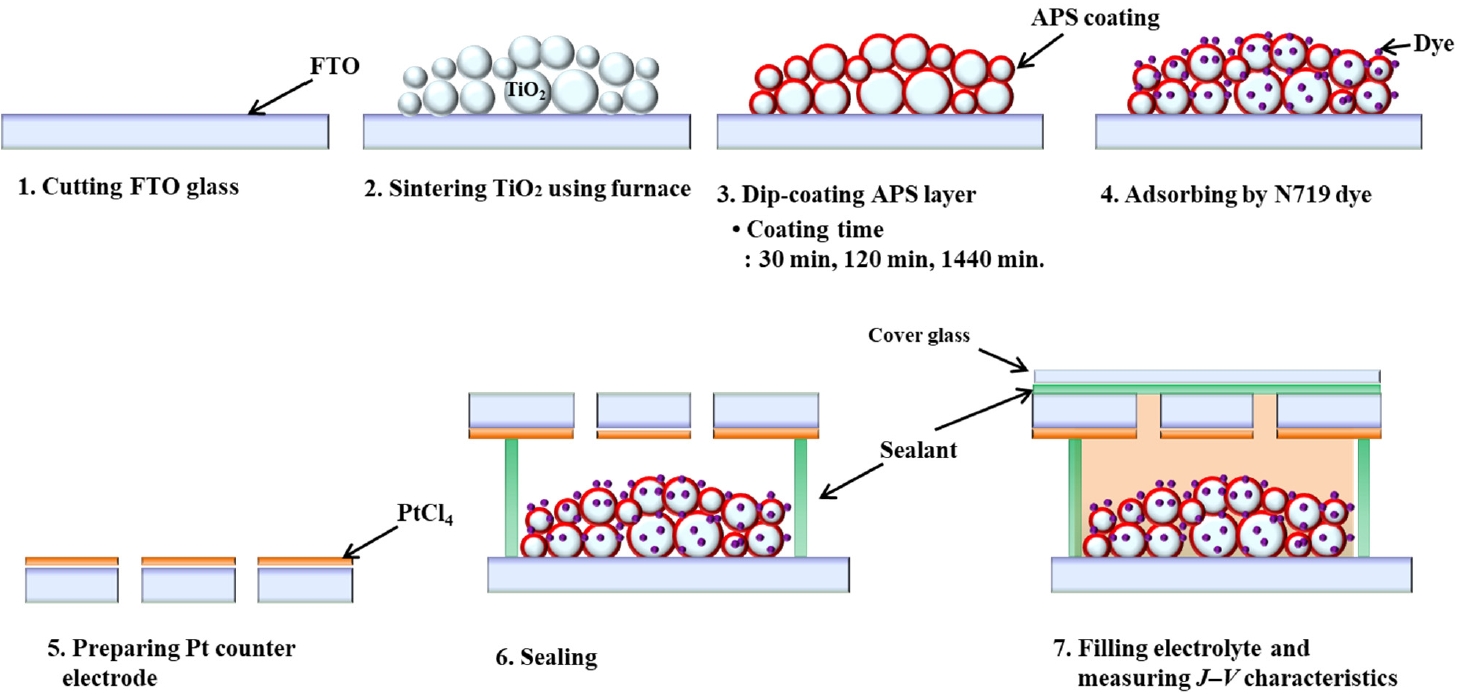
Surface modification of nanoporous TiO₂ photoelectrodes was carried out using APS to investigate the effect of silanization time on interfacial charge transport behavior in DSSCs (
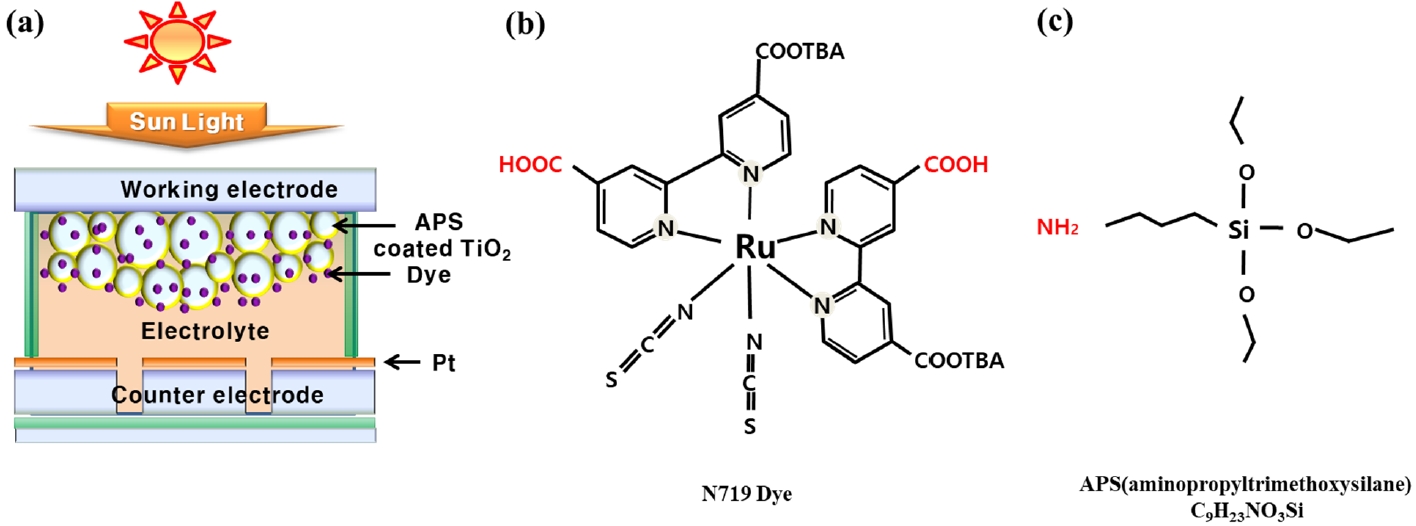
Fig. 1). The interfacial interaction mechanism between APS and N719 dye molecules is schematically illustrated in
Fig. 2. APS molecules are known to form covalent Si–O–Ti bonds with hydroxyl groups on TiO₂ surfaces through hydrolysis and condensation reactions, while the terminal amine groups can interact with carboxyl groups of N719 dye molecules. These interactions are expected to influence both dye adsorption and interfacial charge transfer characteristics [
22].
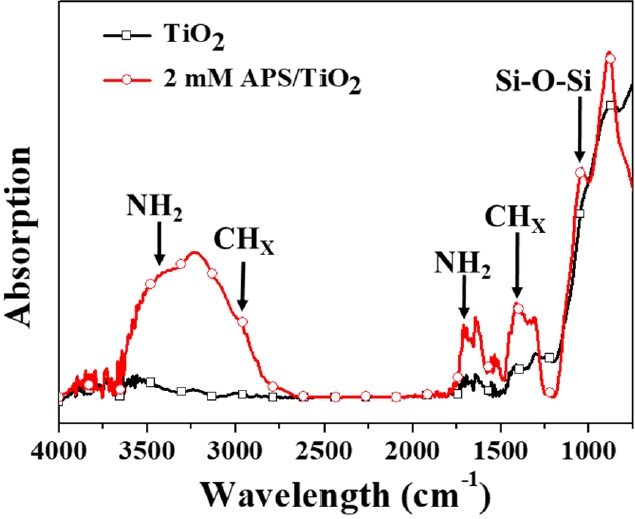
Figure 3 shows the FT-IR spectra of TiO₂ electrodes before and after APS treatment. The appearance of characteristic peaks corresponding to N–H stretching (~3,400 cm⁻¹), C–H stretching (~2,980–2,850 cm⁻¹), and Si–O–Si bonding (~1,100 cm⁻¹) confirms the successful introduction of APS molecules onto the TiO₂ surface. These chemical features confirm the formation of APS-related functional groups that can contribute to interfacial passivation and dye adsorption, consistent with previous reports on organosilane-modified oxide surfaces [
21,
23].
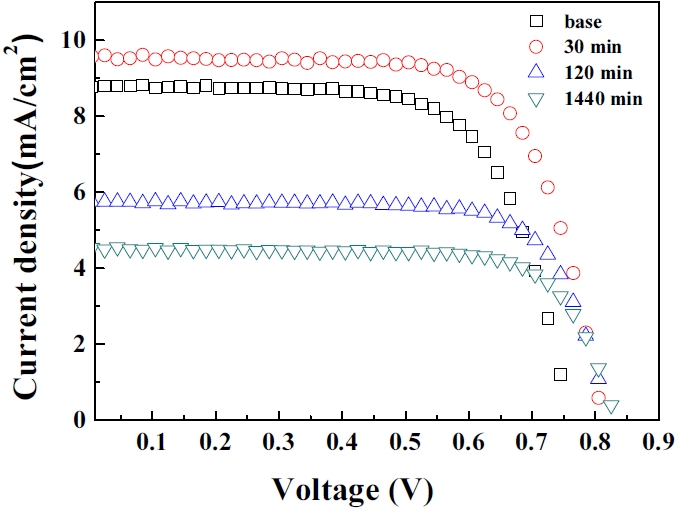
Figure 4 presents the
J–V characteristics of DSSCs fabricated with different APS coating times, and the corresponding photovoltaic parameters are summarized in
Table 1. The untreated device exhibited a power conversion efficiency of 4.49% with a
Jsc of 8.79 mA/cm² and an
Voc of 0.757 V. Upon APS treatment for 30 min, the efficiency increased to 5.34%, corresponding to a 19% enhancement. This improvement is mainly attributed to the increase in
Jsc (from 8.79 to 9.57 mA/cm²) and
Voc (from 0.757 to 0.810 V), indicating enhanced charge collection and reduced recombination.
The improved performance at 30 min can be interpreted as a result of effective surface functionalization. Moderate APS treatment is expected to enhance dye adsorption through electrostatic interaction between the amine groups of APS and the carboxyl groups of N719 dye molecules, leading to improved light harvesting and increased photocurrent generation. In addition, the APS-modified interface can partially suppress direct contact between TiO₂ and electrolyte species, thereby reducing interfacial recombination and improving Voc.
However, further increasing the coating time to 2 h and 24 h resulted in a significant decrease in photovoltaic performance. The Jsc decreased from 9.57 mA/cm² (30 min) to 5.74 mA/cm² (2 h) and 4.50 mA/cm² (24 h), while the overall efficiency dropped to 3.40% and 2.72%, respectively. Interestingly, Voc showed a slight increase with prolonged coating time (up to 0.832 V), suggesting that recombination suppression may still be effective, while charge generation or transport becomes limited.
Although prolonged APS treatment increased recombination resistance and electron lifetime, the photocurrent density significantly decreased. This result indicates that suppression of recombination pathways does not necessarily guarantee efficient charge injection or electron transport. Recent studies have also reported that interfacial engineering critically affects charge extraction efficiency and carrier transport behavior in photovoltaic devices through modulation of interfacial morphology and carrier extraction pathways [
24,
25].
In DSSCs, Jsc is strongly influenced not only by recombination behavior but also by electron injection efficiency and interfacial electronic coupling between dye molecules and the TiO₂ surface. Excessive APS treatment is expected to induce increased Si–O–Si condensation and formation of denser silane networks, which may partially hinder electronic interaction between N719 dye molecules and TiO₂. As a result, electron injection efficiency can decrease despite improved recombination resistance.
Meanwhile, the gradual increase in FF and Voc with prolonged coating time can be attributed to suppression of back electron transfer and reduced interfacial recombination caused by the APSinduced passivation layer. Therefore, APS silanization introduces competing interfacial effects involving recombination suppression and charge injection limitation, leading to the observed trade-off behavior.
This behavior indicates that excessive APS treatment can negatively affect charge transport despite improving recombination resistance. With increasing coating time, the APS-modified interface is expected to evolve toward higher surface coverage accompanied by silane condensation through Si–O–Si bonding. Such condensation reactions are known to occur during prolonged silanization processes, leading to the formation of more densely packed or partially polymerized silane networks on oxide surfaces [
21,
23]. Although the exact thickness of the APS layer was not directly measured in this study, this evolution of the interfacial layer can reduce electronic coupling between dye molecules and the TiO₂ surface, thereby limiting electron injection and decreasing photocurrent density.
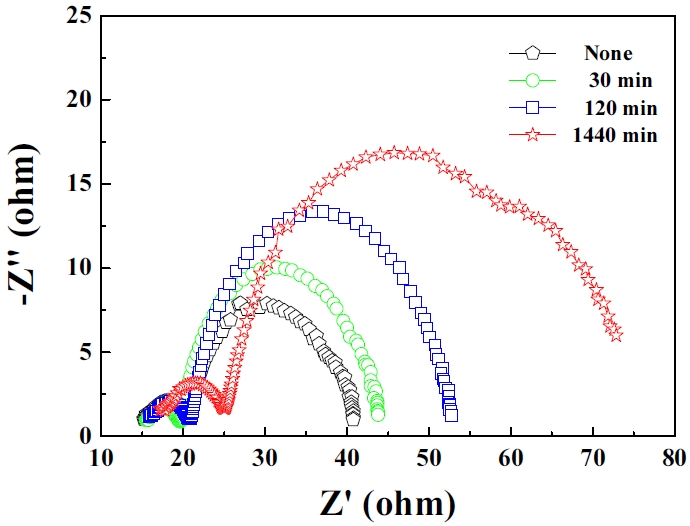
Electrochemical impedance spectroscopy (EIS) analysis was performed to further investigate the influence of APS coating time on interfacial charge transfer behavior.
Figure 5 shows the Nyquist plots of DSSCs with different coating times. The diameter of the semicircle in the middle-frequency region, corresponding to the charge transfer resistance at the TiO₂/dye/electrolyte interface, increased with APS treatment, indicating enhanced recombination resistance due to surface passivation. This behavior is consistent with typical impedance responses observed in DSSCs with interfacial passivation layers, where increased recombination resistance reflects suppressed back electron transfer processes [
26]. The observed increase in recombination resistance, together with the simultaneous increase in
Voc and decrease in
Jsc, indicates that interfacial modification affects recombination suppression and charge injection in opposite directions. These results suggest that the evolution of the APS-modified interface is governed by silanization time rather than precursor concentration. Accordingly, silanization time plays a critical role in determining the balance between recombination suppression and charge injection efficiency.
The electron lifetime (τₙ) was calculated from the characteristic frequency using the following relationship:
where fmax represents the peak frequency obtained from the Bode phase plot. The calculated τₙ values listed in
Table 2 show an increase with APS surface treatment, indicating suppression of recombination pathways at the TiO₂/dye/electrolyte interface.
Therefore, the photovoltaic performance of DSSCs modified with APS is governed by a trade-off between recombination suppression and charge injection efficiency. While moderate silanization enhances interfacial properties and improves device performance, excessive surface modification leads to increased interfacial resistance and reduced electronic coupling, ultimately limiting photocurrent generation. Such trade-off behavior has also been reported in DSSCs incorporating insulating interfacial layers or molecular modifiers [
6-
8,
26].
The increase in recombination resistance observed from EIS analysis suggests effective suppression of back electron transfer at the TiO₂/dye/electrolyte interface. However, excessive APS coverage can simultaneously increase interfacial charge transfer resistance and reduce electronic coupling between the dye molecules and TiO₂. Consequently, electron lifetime enhancement does not directly correspond to improved photocurrent generation under prolonged silanization conditions.
4 Conclusion
APS surface modification was applied to nanoporous TiO₂ photoelectrodes to investigate the effect of silanization time on interfacial charge transport properties in dye-sensitized solar cells. The APS molecular layer was successfully introduced onto the TiO₂ surface through dip-coating, and its interfacial role was confirmed by FT-IR and electrochemical analyses.
The device treated for 30 min exhibited the highest power conversion efficiency of 5.34%, corresponding to a 19% improvement over the untreated electrode, due to enhanced dye adsorption and suppressed interfacial recombination. In contrast, prolonged coating times led to a significant decrease in photocurrent density despite improved recombination resistance, indicating the presence of competing interfacial effects.
These results demonstrate that APS silanization time critically determines the balance between interfacial passivation and charge injection efficiency in DSSCs. Moderate surface functionalization effectively suppresses recombination while maintaining efficient electron transport, whereas excessive silanization leads to increased interfacial resistance and reduced electronic coupling. Therefore, optimization of interfacial reaction kinetics is essential for achieving high photovoltaic performance in APS-modified DSSCs.
Notes
-
Conflict of Interest
The authors have no conflicts of interest to declare.
-
Author Contributions
Jin Wook Lee: Conceptualization, Validation, Formal analysis.
Minjae Shin: Data Curation, Validation.
Byungyou Hong: Supervision, Project administration, Funding acquisition.
Hyung Jin Kim: Writing - Original Draft, Writing - Review & Editing, Visualization, Funding acquisition.
Data Availability
Data available within the article or its supplementary materials.
Fig. 1.Schematic illustration of the dye-sensitized solar cell (DSSC) structure and APS surface modification on the nanoporous TiO₂ photoelectrode. The APS molecular layer acts as an interfacial barrier that suppresses charge recombination between TiO₂ and the electrolyte while enhancing dye adsorption through electrostatic interaction between amine functional groups and carboxyl groups of dye molecules
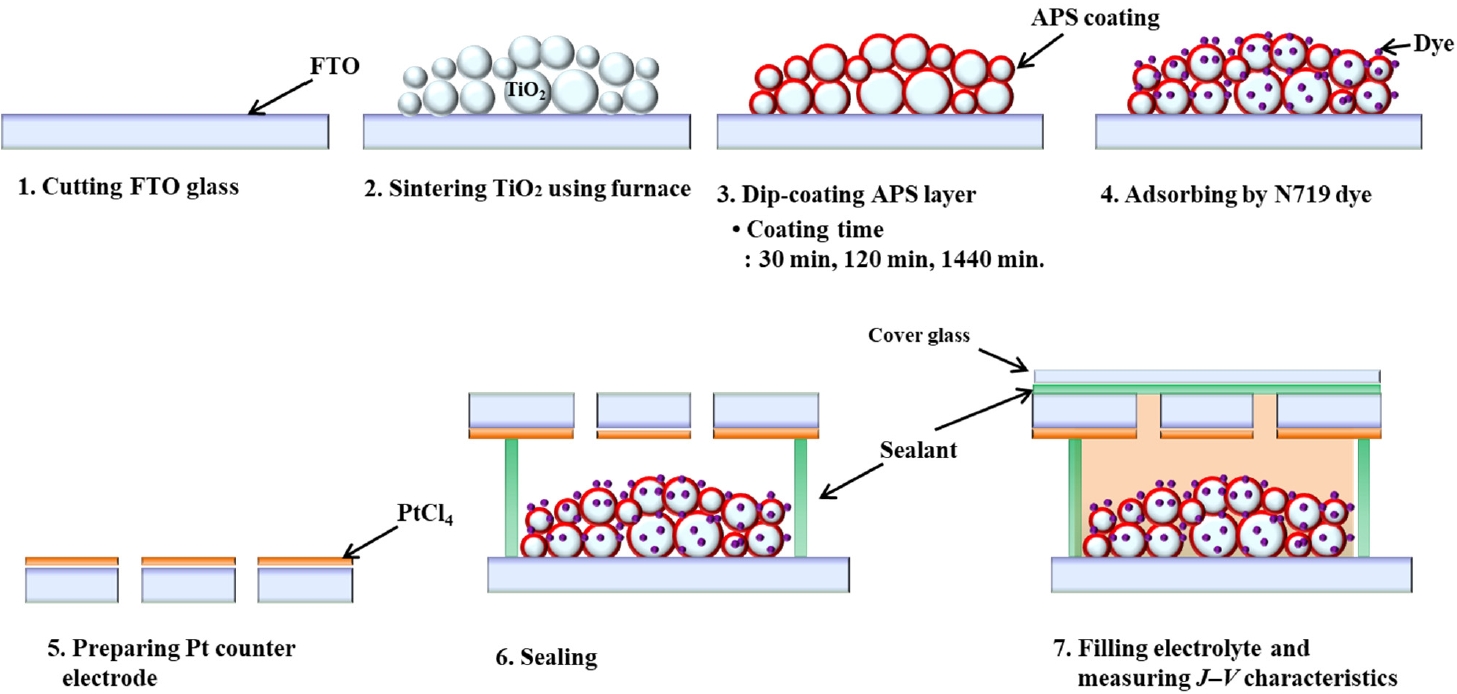
Fig. 2.Proposed interaction mechanism between aminopropyltrimethoxysilane (APS) and N719 dye molecules. The amine (–NH₂) functional group of APS promotes electrostatic interaction with carboxyl (–COOH) groups in the dye, increasing dye adsorption on the TiO₂ surface and improving interfacial charge transfer properties
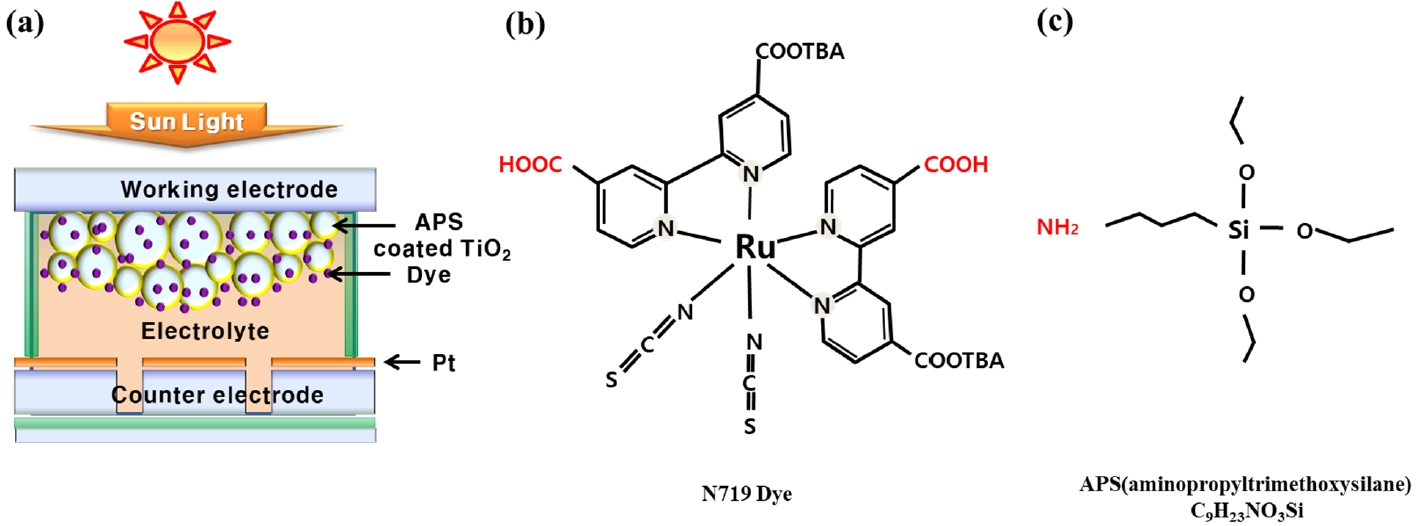
Fig. 3.FT-IR spectra of nanoporous TiO₂ electrodes before and after APS surface treatment. Characteristic peaks corresponding to N–H stretching (~3,400 cm⁻¹), C–H stretching (~2,980–2,850 cm⁻¹), and Si–O–Si bonding (~1,100 cm⁻¹) confirm successful APS functionalization on the TiO₂ surface
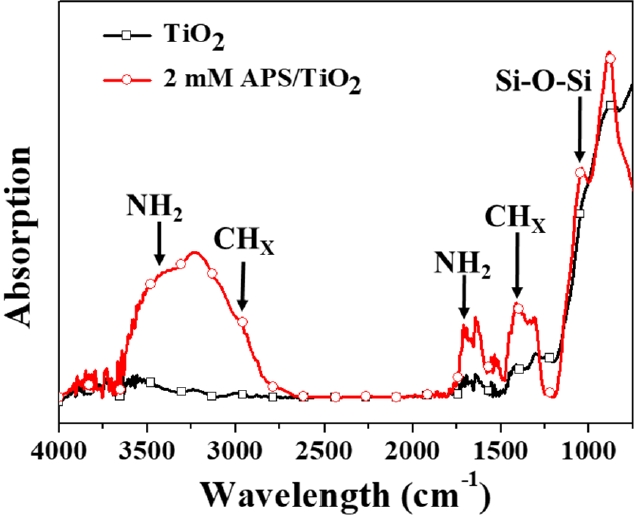
Fig. 4.Current density–voltage (J–V) characteristics of DSSCs fabricated with different APS coating times under AM 1.5 illumination (100 mW/cm²)
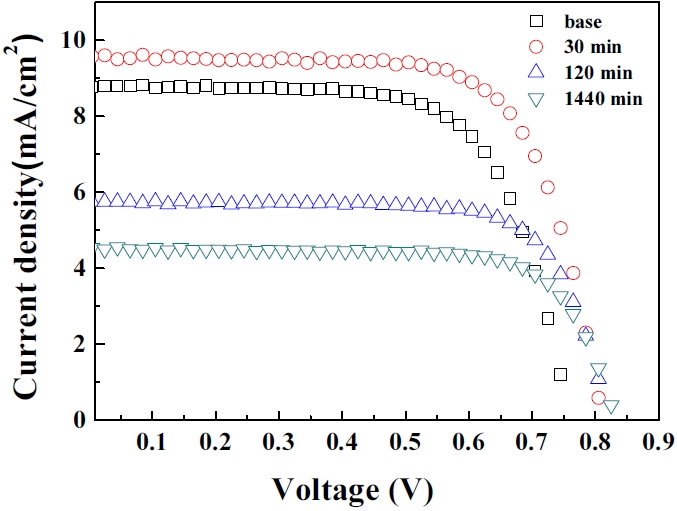
Fig. 5.Nyquist plots of DSSCs with different APS coating times obtained from electrochemical impedance spectroscopy (EIS) measurements
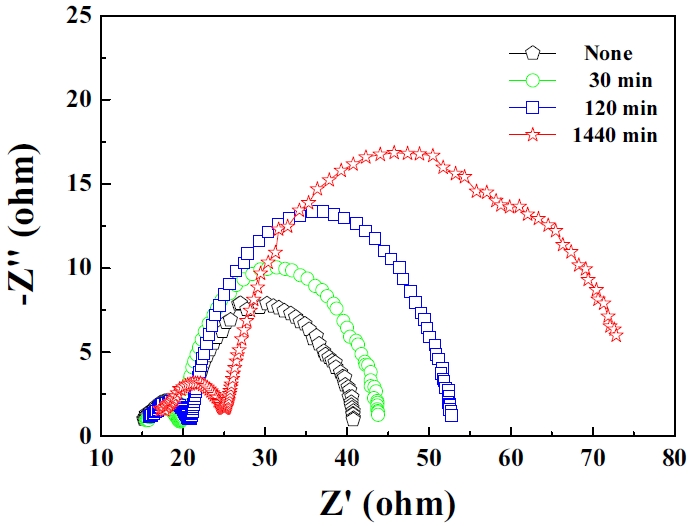
Table 1.Photovoltaic parameters (Jsc, Voc, FF, and efficiency) of DSSCs as a function of APS coating time
Table 1.
|
CE (%) |
Voc (V) |
Jsc (mA/cm²) |
FF (%) |
|
None |
4.49 |
0.757 |
8.79 |
67.5 |
|
30 min |
5.34 (+19%) |
0.810 |
9.57 |
68.9 |
|
2 hours |
3.40 (-25%) |
0.821 |
5.74 |
72.2 |
|
24 hours |
2.72 (-39%) |
0.832 |
4.50 |
72.7 |
Table 2.Impedance parameters and electron lifetime (τₙ) of DSSCs with different APS coating times obtained from EIS analysis
Table 2.
|
None |
30 min |
2 hours |
24 hours |
|
Wmax (Hz) |
8.93 |
7.09 |
7.09 |
5.02 |
|
τe (ms) |
17.8 |
22.4 |
22.4 |
31.7 |
References
- 1. B. O'Regan and M. Grätzel, Nature, 353, 737 (1991). doi: https://doi.org/10.1038/353737a0
- 2. M. Grätzel, J. Photochem. Photobiol. C: Photochem. Rev., 4, 145 (2003). doi: https://doi.org/10.1016/S1389-5567(03)00026-1
- 3. Y. Chiba, A. Islam, Y. Watanabe, R. Komiya, N. Koide, and L. Han, Jpn. J. Appl. Phys., 45, L638 (2006). doi: https://doi.org/10.1143/JJAP.45.L638
- 4. B. C. O’Regan and J. R. Durrant, Acc. Chem. Res., 42, 1799 (2009). doi: https://doi.org/10.1021/ar900145z
- 5. A. Hagfeldt, G. Boschloo, L. Sun, L. Kloo, and H. Pettersson, Chem. Rev., 110, 6595 (2010). doi: https://doi.org/10.1021/cr900356p
- 6. A. Kay and M. Grätzel, Chem. Mater., 14, 2930 (2002). doi: https://doi.org/10.1021/cm0115968
- 7. S. Y. Kwon, W. Yang, and Z. H. Zhang, J. Korean Inst. Electr. Electron. Mater. Eng., 27, 746 (2014). doi: https://doi.org/10.4313/JKEM.2014.27.11.746
- 8. Z. S. Wang, M. Yanagida, K. Sayama, and H. Sugihara, Chem. Mater., 18, 2912 (2006). doi: https://doi.org/10.1021/cm0603102
- 9. Y. Tachibana, J. E. Moser, M. Grätzel, D. R. Klug, and J. R. Durrant, J. Phys. Chem., 100, 20056 (1996). doi: https://doi.org/10.1021/jp962227f
- 10. A. Ulman, Chem. Rev., 96, 1533 (1996). doi: https://doi.org/10.1021/cr9502357
- 11. J. C. Love, L. A. Estroff, J. K. Kriebel, R. G. Nuzzo, and G. M. Whitesides, Chem. Rev., 105, 1103 (2005). doi: https://doi.org/10.1021/cr0300789
- 12. H. S. Park, S. Y. Kwon, and W. Yang, J. Korean Inst. Electr. Electron. Mater. Eng., 25, 537 (2012). doi: https://doi.org/10.4313/JKEM.2012.25.7.537
- 13. A. R. Park, S. H. Kim, D. G. Kim, H. B. Gu, and H. C. Ki, J. Korean Inst. Electr. Electron. Mater. Eng., 25, 620 (2012). doi: https://doi.org/10.4313/JKEM.2012.25.8.620
- 14. X. Chen and S. S. Mao, Chem. Rev., 107, 2891 (2007). doi: https://doi.org/10.1021/cr0500535
- 15. P. Roy, S. Berger, and P. Schmuki, Angew. Chem. Int. Ed., 50, 2904 (2011). doi: https://doi.org/10.1002/anie.201001374
- 16. J. Bisquert, J. Phys. Chem. B, 106, 325 (2002). doi: https://doi.org/10.1021/jp011941g
- 17. Q. Wang, J. E. Moser, and M. Grätzel, J. Phys. Chem. B, 109, 14945 (2005). doi: https://doi.org/10.1021/jp052768h
- 18. A. Fujishima, X. Zhang, and D. A. Tryk, Surf. Sci. Rep., 63, 515 (2008). doi: https://doi.org/10.1016/j.surfrep.2008.10.001
- 19. U. Diebold, Surf. Sci. Rep., 48, 53 (2003). doi: https://doi.org/10.1016/S0167-5729(02)00100-0
- 20. E. Favilla, G. Cittadino, S. Veronesi, M. Tonelli, S. Fischer, J. C. Goldschmidt, A. Cassanho, and H. P. Jenssen, Sol. Energy Mater. Sol. Cells, 157, 415 (2016). doi: https://doi.org/10.1016/j.solmat.2016.05.005
- 21. J. A. Howarter and J. P. Youngblood, Langmuir, 22, 11142 (2006). doi: https://doi.org/10.1021/la061240g
- 22. L. T. Zhuravlev, Colloids Surf. A Physicochem. Eng. Asp., 173, 1 (2000). doi: https://doi.org/10.1016/S0927-7757(00)00556-2
- 23. M. A. Brook, Silicon in Organic, Organometallic, and Polymer Chemistry, (Wiley, New York, 2000)
- 24. S. S. Yang and Y. S. Park, J. Korean Inst. Electr. Electron. Mater. Eng., 36, 36 (2023). doi: https://doi.org/10.4313/JKEM.2023.36.1.6
- 25. S. Hong, H. Jeong, H. Kang, and S. Sohn, J. Korean Inst. Electr. Electron. Mater. Eng., 37, 451 (2024). doi: https://doi.org/10.4313/JKEM.2024.37.4.14
- 26. X. Yu, J. Deng, X. Yang, J. Li, Z. H. Huang, B. Li, and F. Kang, Nano Energy, 67, 104256 (2020). doi: https://doi.org/10.1016/j.nanoen.2019.104256