ABSTRACT
This paper reviews the energy yield enhancement characteristics of bifacial photovoltaic systems combined with solar tracking, focusing on their performance relative to conventional monofacial fixed-tilt configurations. The fundamental mechanisms of yield improvement are summarized, highlighting the largely additive contributions of solar tracking, which increases front-side irradiance, and bifacial modules, which utilize rear-side reflected and diffuse radiation. Reported results from previous studies indicate that bifacial systems with single-axis tracking typically achieve 25–35% higher annual energy yield compared with standard monofacial fixed-tilt systems, with variations depending on environmental and design conditions. Key design and environmental considerations influencing system performance are discussed to provide practical insights for the application of bifacial tracking systems in utilityscale photovoltaic installations.
-
KEYWORDS: Bifacial photovoltaic modules, Solar tracking systems, Energy yield enhancement, Utility-scale photovoltaic systems, System design considerations
1 Introduction
전 세계적으로 태양광 발전은 재생에너지 중심의 시대에 에너지 대전환을 이끄는 핵심 기술로 자리 잡고 있다[
1–
5]. 최근 수년간 태양광 모듈 가격의 지속적인 하락과 시스템 효율의 향상으로 인해 대규모 태양광 발전소의 보급이 빠르게 확대되고 있으며, 전력 수요 증가와 토지 이용 제약이 동시에 존재하는 지역을 중심으로 설치 면적 대비 발전량을 극대화 하는 기술적 요구가 점점 더 중요해지고 있다. 이에 따라 단순한 설비 용량 확대보다는, 동일한 토지와 인프라 조건에서 더 많은 에너지를 생산할 수 있는 고효율 태양광 시스템 구성에 대한 관심이 증가하고 있다. 기존의 단면(monofacial) 태양광 모듈과 고정 경사각(fixed-tilt) 구조는 구조적 단순성과 낮은 초기 비용이라는 장점을 가지고 있지만, 입사각 손실과 후면 반사광의 미활용으로 인해 에너지 수율 측면에서는 한계를 가진다[
6]. 이러한 한계를 극복하기 위한 대안으로 양면(bifacial) 태양광 모듈과 태양 추적(tracking) 시스템이 각각 독립적으로 개발·보급되어 왔다[
7,
8]. 양면 모듈은 전면뿐만 아니라 후면에서도 태양 복사 에너지를 수집함으로써 지표 반사광과 산란광을 활용할 수 있으며, 태양 추적 시스템은 태양의 일주 운동을 따라 모듈의 방향을 조절함으로써 입사각 손실을 최소화하고 전면 조사량을 증가시킨다.
최근에는 이 두 기술을 결합한 양면 모듈–추적 시스템 조합(bifacial PV with tracking systems)이 차세대 대규모 태양광 발전 구성으로 주목받고 있다. 태양 추적은 전면 조사량을 극대화하는 동시에 모듈의 기울기와 높이를 변화시켜 후면 조사 조건에도 영향을 미치며, 이러한 동적 거동은 양면 모듈의 발전 성능을 추가적으로 향상시킬 수 있다. 다수의 선행연구와 실증 결과에 따르면, 양면 모듈과 추적 시스템은 각각의 성능 향상이 단순히 중첩되는 것이 아니라, 특정 조건에서는 상호 보완적인 효과를 통해 에너지 수율을 더욱 크게 증가시키는 경향을 보인다[
9–
11]. 특히 단축 태양 추적기(single-axis tracker)를 적용한 양면 태양광 시스템은 고정식 단면 시스템 대비 유의미한 에너지 수율 향상을 달성하면서도 경제성과 구조적 안정성을 동시에 확보할 수 있는 구성으로 평가되고 있다. 이러한 시스템은 직달일사량(DNI)이 높은 사막 지역뿐만 아니라, 산란광 비중이 높은 지역이나 계절적 적설이 발생하는 고위도 지역에서도 일관된 성능 개선 효과를 나타내는 것으로 보고되고 있다. 대한민국 또한 해양성 기후의 영향을 받는 중위도 지역에서 연중 산란광 비중이 상대적으로 높고, 겨울철 적설에 따른 지표 반사 효과가 존재하여, 양면–추적 시스템의 적용 가능성을 검토하기에 적합한 환경을 제공한다. 이에 따라 양면–추적 조합은 특정 기후나 지형에 국한된 기술이 아니라, 다양한 환경 조건에서 적용 가능한 범용적 대안으로 인식되고 있다. 그럼에도 불구하고 양면 태양광 모듈과 추적 시스템의 결합 효과는 지표 반사율, 시스템 기하 구조, 추적기 형식, 설치 환경 등 다수의 요인에 의해 크게 달라질 수 있으며, 이러한 요소들이 실제 에너지 수율 향상에 어떻게 기여하는지에 대해서는 여전히 체계적인 정리가 필요하다. 특히 국내외 문헌에서는 개별 실험 결과나 특정 지역 사례가 다수 보고되고 있으나, 이를 종합적으로 비교·정리하여 핵심적인 성능 경향과 설계 시 고려사항을 도출한 리뷰 연구는 제한적이다.
본 논문에서는 양면 태양광 모듈과 태양 추적 시스템을 결합한 태양광 발전 구조를 대상으로, 에너지 수율 향상 메커니즘과 대표적인 성능 개선 범위를 중심으로 기존 연구 결과를 종합적으로 검토한다. 복잡한 모델링 기법이나 세부 계측 방법보다는, 다양한 연구와 실증 사례에서 공통적으로 관찰되는 성능 경향과 설계 관점에서의 시사점을 정리하는 데 초점을 둔다. 이를 통해 양면–추적 태양광 시스템이 표준적인 대규모 태양광 발전 구성으로서 갖는 기술적 의미를 명확히 하고, 향후 시스템 설계 및 연구 방향 설정에 참고가 될 수 있는 기초 자료를 제공하고자 한다.
2 양면 태양광 모듈과 태양광 추적 시스템에 의한 에너지 수율 향상
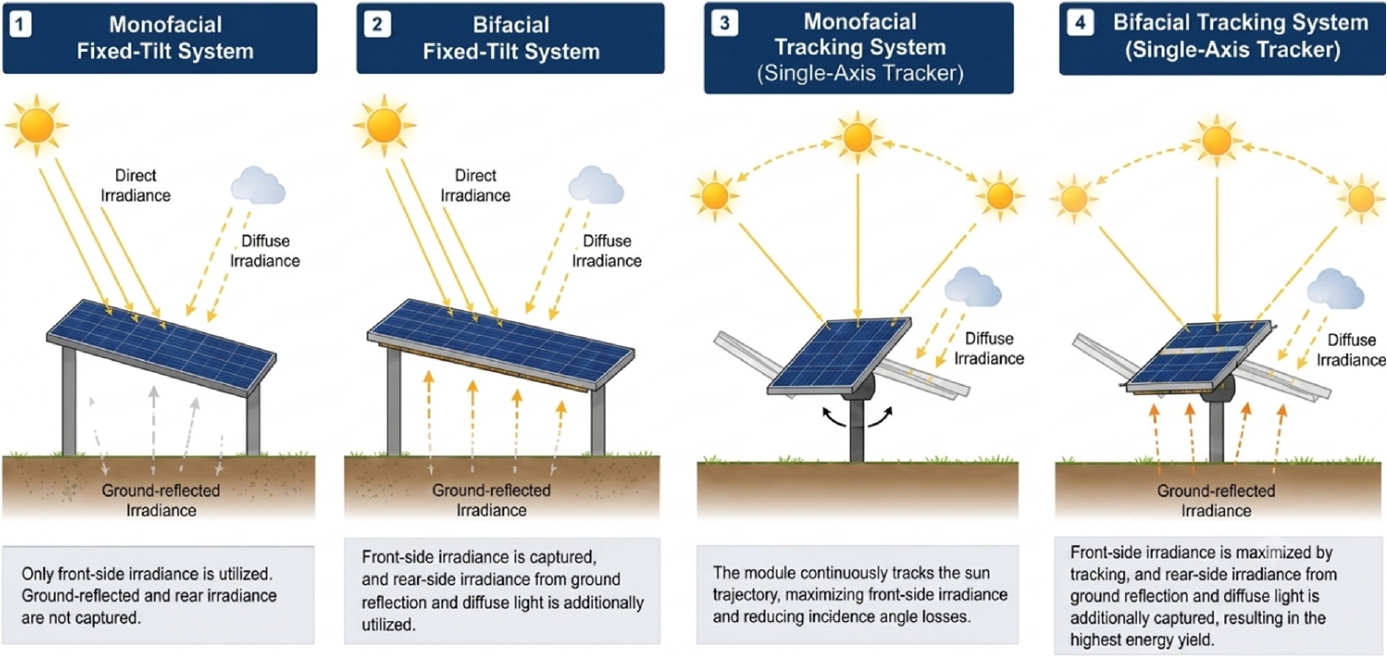
그림 1에서 제시한 것과 같이 고정식 양면 태양광 모듈은 전면(front side)뿐만 아니라 후면(rear side)에서도 태양 복사 에너지를 수집할 수 있도록 설계된 모듈이다. 기존 단면 모듈의 경우, 지표면에서 반사되거나 주변 환경에서 산란된 복사 에너지는 대부분 활용되지 못하고 손실로 작용하지만, 양면 모듈은 지면으로부터 반사되어 산란된 조사 (Groundreflected irradiance)광에 의해 전력 생산에 기여하도록 활용할 수 있다. 양면 모듈의 성능 향상은 일반적으로 양면 이득(bifacial gain)이라는 지표로 표현되며, 이는 단면 모듈 대비 추가로 확보되는 발전량의 비율을 의미한다[
12]. 선행 연구들에 따르면 양면 이득은 지표 반사율(albedo), 모듈 설치 높이, 행 간 간격, 구조물에 의한 차광 조건 등에 크게 의존한다[
13,
14]. 또한 자연 지표면 조건에서도 양면 모듈은 단면 모듈 대비 유의미한 에너지 수율 향상을 보이는 것으로 다수의 연구에서 보고되고 있으며, 이러한 경향은 밝은 지표면이나 적설 환경에서는 더욱 뚜렷하게 나타난다[
15]. 다만, 이러한 성능 향상은 후면 조사 조건에 민감하게 반응하므로, 단순히 모듈 자체의 특성뿐만 아니라 시스템 레벨의 설계와 설치 환경이 중요한 역할을 한다.
태양 추적 시스템은 태양의 일주 운동을 따라 모듈의 방향을 지속적으로 조절함으로써 전면 조사량을 극대화하는 기술이다. 고정 경사각 시스템에서는 태양 고도와 방위각 변화에 따라 입사각 손실이 발생하지만, 추적 시스템은 이러한 손실을 줄여 하루 동안 더 많은 직달 일사량을 모듈 표면에 입사된다. 대규모 태양광 발전소에서 가장 널리 사용되는 방식은 단축 태양 추적기(single-axis tracker)로, 일반적으로 동–서 방향 회전을 통해 하루 동안의 태양 경로를 추적하는데 이는 고정식 시스템 대비 단위 면적당 에너지 생산량이 약 15~25%가 더 높은 것으로 보고되고 있다[
16–
18]. 이는 양면 모듈만 적용했을 경우와 비교해봐도 자연 지표 조건에서 약 5–15%의 추가적인 이득이 관찰되기 때문이다. 특히, 직달 일사량 비중이 높은 지역에서 두드러지게 나타나지만, 산란광이 많은 환경에서도 일정 수준의 성능 개선 효과를 제공한다. 이축 추적 시스템(dual-axis tracker)은 고정식 시스템과도 비교했을 때 이론적으로 약 30~40%의 더 높은 조사량 확보가 가능한데 두 기술의 상호 보완에 의해 작동하기 때문이지만[
19–
21], 구조적 복잡성과 비용 증가로 인해 대규모 상용 시스템에서는 제한적으로 활용되고 있다. 따라서 실제 발전 시스템에서는 단축 추적 방식이 성능과 경제성의 균형 측면에서 가장 현실적인 대안으로 평가되고 있다.
또한 태양 추적 시스템은 모듈의 기울기와 공간 배치를 동적으로 변화시키므로, 후면 조사 분포에도 간접적인 영향을 미친다. 특히 오전과 오후 시간대에는 모듈 하부로 유입되는 반사광과 산란광의 비중이 증가할 수 있으며, 이는 양면 모듈의 후면 발전 기여도를 더욱 증대시키는 요인으로 작용한다[
22]. 이러한 특성은 양면–추적 조합이 특정 시간대 또는 특정 환경 조건에서 추가적인 성능 향상을 보이는 이유로 해석될 수 있다. 양면 태양광 모듈과 태양 추적 시스템의 결합에 따른 성능 향상은 복잡한 수식이나 세부 모델링 없이도 다음과 같은 핵심 메커니즘으로 요약할 수 있다. 첫째, 태양 추적은 전면 조사량을 증가시켜 기본적인 발전 잠재력을 확대한다. 둘째, 양면 모듈은 기존에 활용되지 않던 후면 조사 성분을 추가적인 발전원으로 전환한다. 셋째, 두 기술의 결합은 이러한 효과를 상호 보완적으로 증폭시켜, 다양한 기후와 지형 조건에서 일관된 에너지 수율 향상을 가능하게 한다[
15,
18,
23].
3 태양전지 기술 및 Albedo 값에 따른 양면성 계수와 추적기 활용에 따른 에너지 수율
태양광 발전(PV) 시장은 그리드 패리티(Grid Parity) 도달 이후, LCOE(균등화 발전 비용)를 더욱 낮추기 위해 고효율 모듈과 발전량 증대 기술에 집중하고 있다. 이번장에서는 실리콘 웨이퍼 기반의 태양전지 기술, 모듈 레벨의 효과 그리고 시스템 레벨에 대해 비교하여 분석하고자 한다.
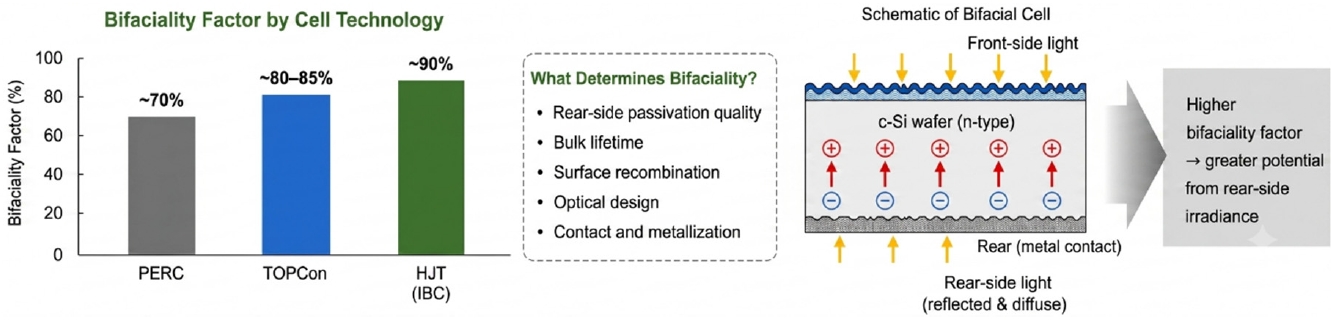
그림 2는 태양전지 기술 레벨에 있어 양면형 모듈을 제작하기 위해 주로 쓰이는 태양전지 기술에 대해 나열하였고 대표적으로 p-PERC (p-type passivated emitter rear contact)가 시장을 주도하고 있다. PERC 구조는 후면에 유전체 층을 도입하여 빛을 반사시키고 재결합을 줄이지만, 양면형으로 제작할 경우 후면 전극의 그리드 설계 문제로 인해 양면성 계수가 약 70% 수준으로 제한된다. 또한, p형 웨이퍼 특유의 붕소-산소 복합체에 의한 광유도 열화(LID) 현상은 장기적인 에너지 수율 측면에서 약점으로 작용한다[
24]. 반면 n-PERT 기술은 n형 웨이퍼를 사용하여 LID 문제를 해결하고 구조적으로 양면형에 더 적합한 특성을 가진다. n-PERT는 n형 베이스와 후면 전체에 도핑된 층을 가지며, 이를 통해 TOPCon으로의 기술적 징검다리 역할을 수행해 왔다. 그러나 n-PERT의 양면성 계수는 75~80% 수준으로 향후 기술들과 비교해 상대적으로 낮으며, 양산 효율 또한 22% 내외에 머물러 있다[
25,
26]. 현재 가장 강력한 성장세를 보이는 n-TOPCon (n-type tunnel oxide passivated contact) 기술은 PERC 제조 공정을 기반으로 후면에 초박막 터널 산화막(SiO2)과 도핑에 의한 다결정 실리콘(n+ poly-Si) 층을 추가하여 계면 패시베이션(Passivation) 특성을 극대화한다. TOPCon 기술은 캐리어 선택적 접합을 통해 개방전압(VOC) 손실을 크게 줄였으며, 양면성 계수를 80~85%까지 끌어올렸다[
27]. HJT (heterojunction technology)와 같은 차세대 기술은 결정질 실리콘과 비정질 실리콘 박막기술을 결합하여 고효율과 저온 공정을 동시에 달성한다. HJT는 대칭적인 구조적 특성 덕분에 90% 이상의 매우 높은 양면성 계수를 보유하고 있으며, 이는 후면 수광량이 많은 환경에서 압도적인 수율 우위를 제공한다. 또한 HJT는 −0.24%/°C 수준의 극히 낮은 온도 계수를 보여 고온 환경에서도 출력 저하가 적다는 강력한 장점을 지닌다.
실증 연구에 따르면 TOPCon 모듈은 PERC 모듈에 비해 후면 전극에 의해 가려진 음영 (Shading) 면적이 현저히 적다. 한 연구에서 TOPCon의 후면 금속 음영 비율이 8.35%이지만 PERC는 20.81%에 달해, TOPCon 태양전지 후면부의 광흡수 측면에서 구조적으로 우위에 있음을 확인했다. 이는 TOPCon이 단순 효율 외에 실제 가동 환경에서 더 높은 단락전류(Isc)를 생성하기 때문이다. 특히 아침과 저녁 시간대처럼 산란광 비중이 높은 경우, 높은 양면성 계수를 가진 TOPCon과 HJT 모듈은 PERC 대비 10% 이상의 추가 전류를 생성하며 발전 시간을 연장시키는 효과를 가져온다. 이는 양면 모듈이 지면에서 반사된 빛과 산란광을 후면에서 흡수하는데 이는 모듈이 태양을 향하므로 후면이 받는 지면 반사광의 시야각이 최적화되는 경향이 있다.
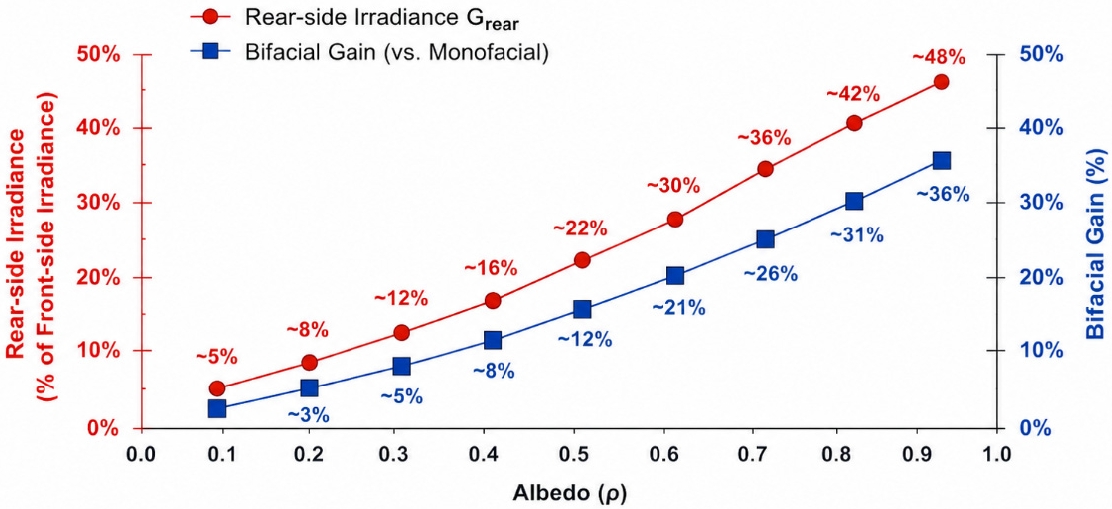
그림 3은 Albedo 값에 따른 후면 조사 비율과 Bifacial gain 에 대해 나타낸 것이다. Albedo 값 약 0.5에서 양면 이득율이 약 12%이지만 Albedo 값 0.9 이상에서 36%로 3배가량 증가하는데 지면이 마치 눈과 같은 흰색의 표면에 의해 후면 조사량의 급격한 증가는 산란광 증가로 이어져 Bifacial gain 증가로 이어졌다. 태양 추적 시스템을 적용할 경우, 모듈 표면에 입사하는 전면 조사량이 증가함에 따라 연간 에너지 생산량이 유의미하게 향상된다. 다수의 선행 연구와 현장 실증과 우리가 진행한 시뮬레이션 결과에 따르면, 추적기를 적용한 단면 태양광 시스템은 고정식 시스템(Mono Fixed) 대비 발전 시간이 연장되기 때문에 15~20% 이득을 얻을 수 있는 것으로 보고되고 있다. 이러한 성능 향상은 특히 직달 일사량(DNI) 비중이 높은 지역에서 두드러지게 나타나며, 사막이나 건조 기후 지역에서는 추적 효과가 발전량 증가의 지배적인 요인으로 작용한다. 반면 산란광 비중이 높은 환경에서도 추적 시스템은 입사각 손실을 완화함으로써 일정 수준의 수율 향상 효과를 유지한다. 그러나 양면형 모듈의 추적기까지 활용한다면 시너지 효과로 인해 이득이 무려 27~30% 상승하게 되는데 이는 두 기술의 성능 향상 효과는 대체로 가산적(additive)으로 나타난다. 즉, 태양 추적에 의해 확보되는 전면 조사량 증가 효과와, 양면 모듈에 의해 추가로 활용되는 후면 조사 성분이 서로 독립적으로 기여하여 총 에너지 수율을 증가시키는 구조이다. 기존 연구들을 종합하면, 단축 태양 추적기를 적용한 양면 태양광 시스템은 단면 고정식 시스템 대비 약 25–35% 수준의 연간 에너지 수율 향상을 달성하는 것이 일반적이다. 고반사 지표면이나 적설 환경, 고위도 지역에서는 이보다 더 큰 성능 향상이 보고되기도 하며, 일부 사례에서는 44%에 근접하는 증가율이 관찰되었다. 이러한 결과는 양면–추적기 조합이 단일 기술 적용 대비 가장 큰 발전량 개선 효과를 제공하는 시스템 구성임을 보여준다.
4 양면형 태양광 모듈과 결합된 태양 추적 시스템의 에너지 수율 향상에 영향을 미치는 설계 및 환경 요인
양면 태양광 모듈과 태양 추적기를 결합한 발전 시스템의 성능은 단순히 모듈이나 추적기의 선택에 의해 결정되지 않는다. 실제 에너지 수율은 설치 환경과 시스템 설계 변수의 상호작용에 의해 크게 좌우되며, 동일한 기술 구성을 사용하여 적용해도 지역 및 조건에 따라 성능 향상 정도가 크게 달라질 수 있다. 앞선 절에서 언급한 것과 같이 양면 태양광 모듈의 후면 발전 기여도는 지표 반사율에 직접적으로 의존한다. 고반사 지표면이나 적설 지역에서 특히나 겨울철에 후면 조사 성분이 안정적으로 유지된다. 따라서 양면 태양광 시스템을 설계할 때는 해당 부지의 지표 특성과 계절적 반사율 변화를 사전에 고려하는 것이 중요하다. 양면 태양광 모듈의 설치 높이와 행 간 간격이 후면 조사 조건에 중요한 영향을 미치는데 이는 모듈이 지면에서 일정 높이 이상으로 설치될 경우, 후면으로 유입되는 반사광과 산란광의 가시성이 증가하여 양면 이득이 향상된다. 반면 설치 높이가 낮거나 행 간 간격이 좁은 경우, 인접 모듈이나 구조물에 의한 차광으로 인해 후면 조사량이 감소할 수 있다. 그러나 설치 높이와 간격을 무작정 증가시키는 것은 토지 이용 효율과 구조적 안정성 측면에서 불리할 수 있으므로, 에너지 수율 증가와 토지 활용 간의 균형을 고려한 설계가 요구된다. 이러한 이유로 양면–추적 시스템에서는 기하 구조 최적화가 설계 단계에서 중요한 고려 요소로 작용한다. 태양광 시스템의 성능은 해당 지역의 일사 특성에 크게 의존한다. 직달 일사량 비중이 높은 사막 및 건조 기후 지역에서는 태양 추적 시스템의 효과가 지배적으로 나타나며, 양면 모듈의 추가적인 기여는 상대적으로 제한적일 수 있다. 반면 산란광 비중이 높은 해안이나 온대 기후 지역에서는 후면 조사 성분의 비중이 증가하여 양면 모듈의 역할이 상대적으로 중요해진다. 또한 고위도 지역에서는 낮은 태양 고도와 긴 그림자 조건으로 인해 추적 시스템과 양면 모듈의 결합 효과가 더욱 두드러질 수 있다. 이와 같이 기후 및 조사 특성은 양면–추적 시스템의 성능에 복합적으로 작용하므로, 특정 지역에 대한 획일적인 설계 기준보다는 환경 특성을 반영한 접근이 필요하다.
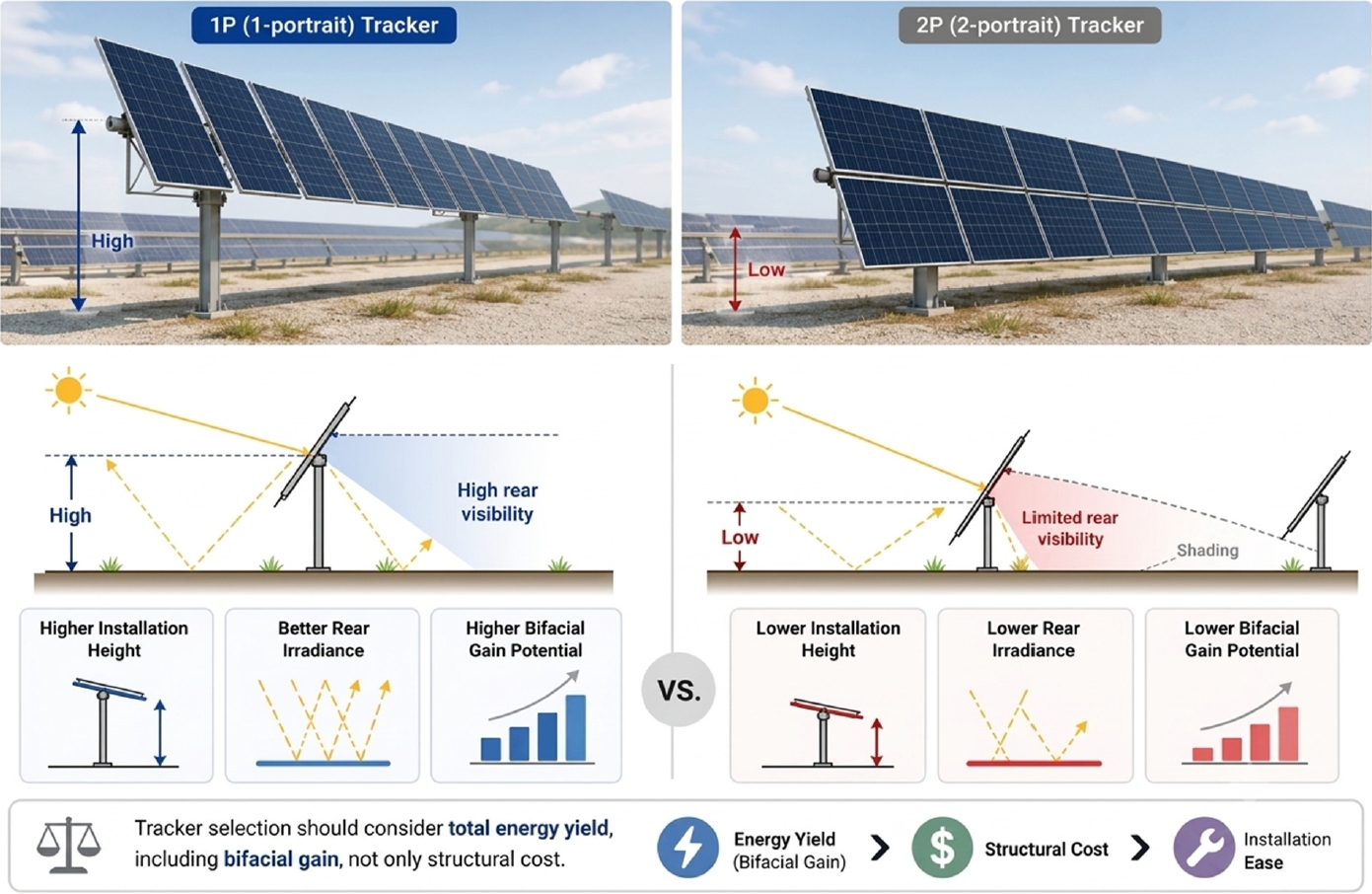
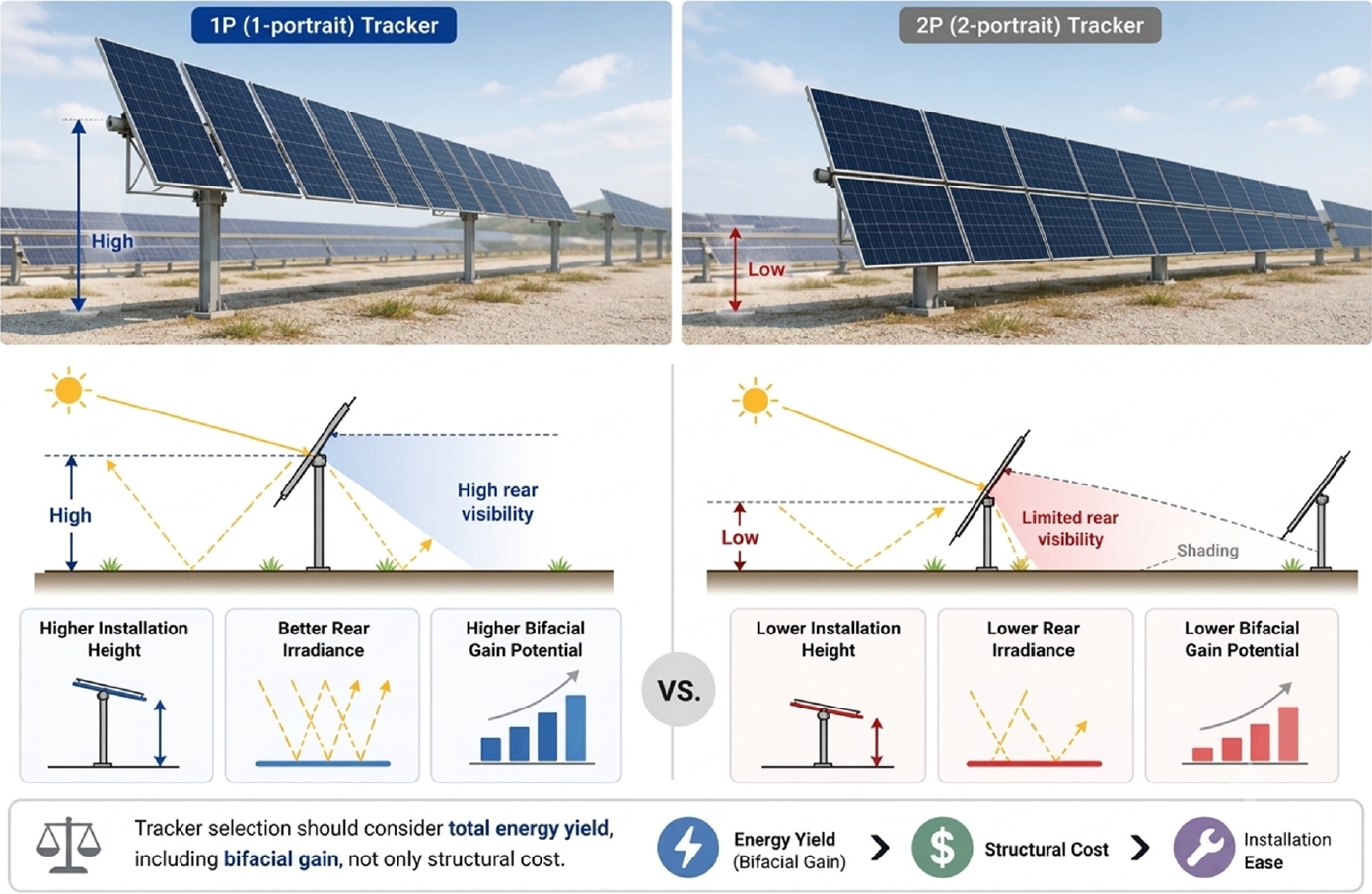
그림 4는 대규모 태양광 발전소에서 주로 사용되는 단축 태양 추적기는 모듈의 배열 방식에 따라 1-portrait(1P)와 2-portrait(2P) 구조로 구분된다. 일반적으로 1P 구조는 모듈의 설치 높이가 상대적으로 높고 후면 가시성이 우수하여 양면 이득 측면에서 유리한 경향을 보인다. 반면 2P 구조는 구조적 차광과 낮은 설치 높이로 인해 후면 조사 조건이 제한될 수 있다. 2P 구조가 비용 및 설치 측면에서 장점을 가질 수 있으나, 양면 태양광 모듈과의 조합에서는 추적기 구조가 후면 조사 성능에 미치는 영향을 함께 고려하는 것이 필요하다. 따라서 추적기 선택 시에는 단순한 구조 비용뿐만 아니라, 양면 이득을 포함한 총 에너지 수율 관점에서의 평가가 요구된다. 특히 1P 구조는 향상된 후면 가시성과 높은 설치 높이를 통해 더 큰 양면 이득을 확보할 수 있으며, 이는 발전소 수명 기간 동안 누적 발전량 증가로 이어질 수 있다. 비록 1P 구조가 초기 설치비용 측면에서 다소 불리할 수 있으나, 향상된 에너지 생산량은 추가적인 자본비용(CAPEX)과 운영·유지관리비용(OPEX)을 상쇄할 가능성을 제공한다. 실제로 최근 연구에서는 양면 모듈과 단축 추적기를 결합한 시스템이 고정식 단면 시스템 대비 25–35% 수준의 연간 에너지 수율 향상을 나타내며, 이로 인해 균등화발전비용(levelized cost of electricity, LCOE)이 감소할 수 있음을 보고하고 있다. 따라서 추적기 구조의 선택은 단순한 구조적 비용이나 시공 편의성뿐만 아니라, 발전소의 전 수명주기에 걸친 총 에너지 생산량과 경제성을 함께 고려하여 이루어져야 한다.
이처럼 양면 태양광 모듈과 태양 추적 시스템의 성능에 영향을 미치는 요소들은 독립적으로 작용하지 않으며, 상호작용을 통해 복합적인 영향을 미친다. 예를 들어, 지표 반사율이 높은 환경에서는 설치 높이 증가에 따른 양면 이득이 더욱 크게 나타날 수 있으며, 추적기 구조에 따른 차광 효과 역시 지표 조건과 결합되어 성능에 영향을 준다. 이러한 특성으로 인해 양면–추적 태양광 시스템의 최적 설계는 보편적인 단일 기준으로 정의되기 어렵다. 대신 설치 지역의 기후, 지형, 지표 특성, 토지 제약 조건 등을 종합적으로 고려한 현장 맞춤형(site-specific) 설계 접근이 요구된다. 이는 양면–추적 시스템이 단순한 장비 조합을 넘어, 통합적인 시스템 설계 문제임을 시사한다. 이번 내용에서 논의한 바와 같이, 양면 태양광 모듈과 태양 추적 시스템의 성능은 환경적 조건과 설계 변수에 의해 크게 좌우된다. 지표 반사율, 시스템 기하 구조, 기후 특성, 추적기 형식 등은 양면–추적 시스템의 에너지 수율을 결정하는 핵심 요소이며, 이들 간의 상호작용을 고려한 설계가 성능 극대화의 관건이 된다. 이러한 설계 및 환경적 고려사항을 종합할 때, 양면 태양광 모듈과 태양 추적 시스템의 조합은 단순히 고정식 시스템을 대체하는 기술을 넘어, 다양한 조건에 대응 가능한 유연한 대규모 태양광 발전 구성으로 평가될 수 있다.
5 Conclusion
본 논문에서는 양면 태양광 모듈과 태양 추적 시스템을 결합한 태양광 발전 구조를 대상으로, 에너지 수율 향상 메커니즘과 대표적인 성능 개선 범위를 중심으로 기존 연구 결과를 종합적으로 검토하였다. 기존의 단면 고정식 태양광 시스템을 기준으로 비교할 때, 태양 추적 시스템과 양면 모듈은 각각 독립적인 방식으로 발전량을 증가시키며, 두 기술을 동시에 적용할 경우 에너지 수율 향상 효과는 상호 보완적인 특성을 나타낸다. 문헌에 보고된 결과를 종합하면, 단축 태양 추적 시스템은 단면 고정식 시스템 대비 약 15–25%의 에너지 수율 향상을 제공하며, 양면 태양광 모듈은 설치 환경에 따라 약 5–15% 수준의 추가적인 발전량 증가를 가능하게 한다. 이 두 기술을 결합한 양면–추적 태양광 시스템은 일반적으로 25–35% 범위의 총 에너지 수율 향상을 달성하며, 고반사 지표면이나 적설 환경, 고위도 및 고지대 지역에서는 그 이상의 성능 향상도 보고되고 있다. 이러한 결과는 양면–추적 조합이 현재 활용 가능한 태양광 시스템 구성 중 에너지 수율 측면에서 가장 효과적인 대안 중 하나임을 보여준다.
또한 양면–추적 태양광 시스템의 성능이 지표 반사율, 시스템 기하 구조, 기후 및 조사 특성, 추적기 형식 등 다양한 설계 및 환경 요인의 영향을 받는다는 점을 정리하였다. 이러한 요소들은 개별적으로 작용하기보다는 상호작용을 통해 복합적인 영향을 미치므로, 양면–추적 시스템의 설계에는 설치 지역의 특성을 반영한 현장 맞춤형 접근이 필요하다. 이는 양면 태양광 기술이 단순한 모듈 교체가 아닌, 시스템 수준의 설계 최적화를 요구하는 기술임을 시사한다. 종합적으로 볼 때, 양면 태양광 모듈과 태양 추적 시스템의 결합은 제한된 토지와 인프라 조건에서 태양광 발전의 효율을 극대화할 수 있는 실질적인 해결책으로 평가된다. 본 리뷰에서 정리한 성능 경향과 설계 고려사항은 향후 대규모 태양광 발전소의 설계 및 기술 선택 과정에서 기초 자료로 활용될 수 있으며, 국내 태양광 산업과 연구 분야에서도 양면–추적 시스템의 적용 가능성을 검토하는 데 유용한 참고가 될 것으로 기대된다.
Notes
-
Conflict of Interest
The authors have no conflicts of interest to declare.
-
Author Contributions
Hyeong Gi Park: Conceptualization, Validation, Formal analysis, Writing-Original Draft, Writing-Review & Editing, Visualization, and Supervision.
Data Availability
Data available on request from the authors.
Fig. 1.Schematic illustration of energy yield enhancement mechanisms in monofacial and bifacial photovoltaic systems with and without solar tracking. Monofacial fixed-tilt systems utilize only front-side irradiance, whereas bifacial modules additionally capture rear-side reflected and diffuse radiation. Solar tracking increases front-side irradiance by reducing incidence angle losses, while the combination of bifacial modules and tracking enables the simultaneous utilization of front and rear irradiance, resulting in the highest energy yield. The overall performance improvement is largely additive, with typical gains of approximately 15–25% from tracking and 5–15% from bifacial operation, leading to a combined energy yield increase of about 25–35% compared with conventional monofacial fixed-tilt systems
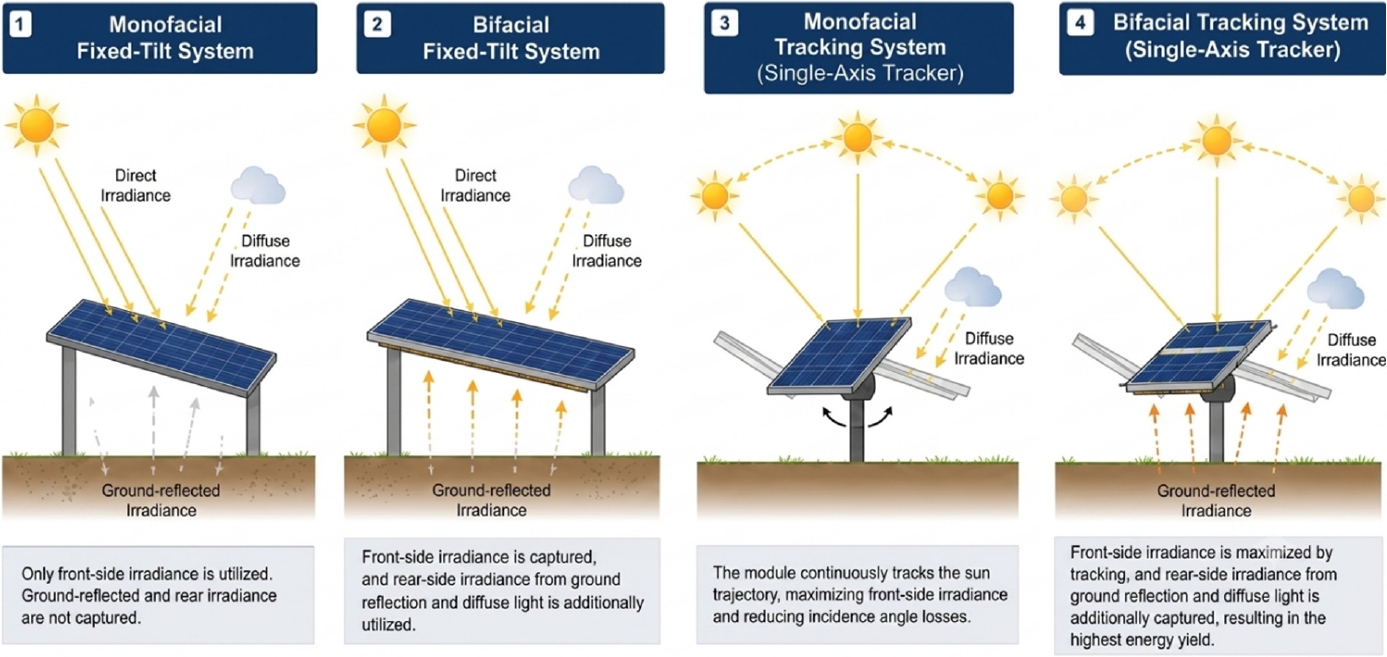
Fig. 2.Comparison of bifaciality factors for representative photovoltaic cell technologies and schematic illustration of carrier transport in a bifacial solar cell. The left panel shows typical bifaciality factors of PERC, TOPCon, and HJT (IBC) structures, indicating that advanced cell architectures generally provide higher rear-side power generation capability. The middle panel summarizes key factors influencing bifaciality, including rear-side passivation quality, carrier lifetime, surface recombination, optical design, and contact metallization. The right panel illustrates the operation of a bifacial solar cell, where front-side illumination and rear-side reflected/diffuse irradiance contribute to carrier generation and enhanced rear-side energy collection. Higher bifaciality factors increase the potential utilization of rear-side irradiance and overall energy yield, Reprinted with permission from Ref. [
24-
27]
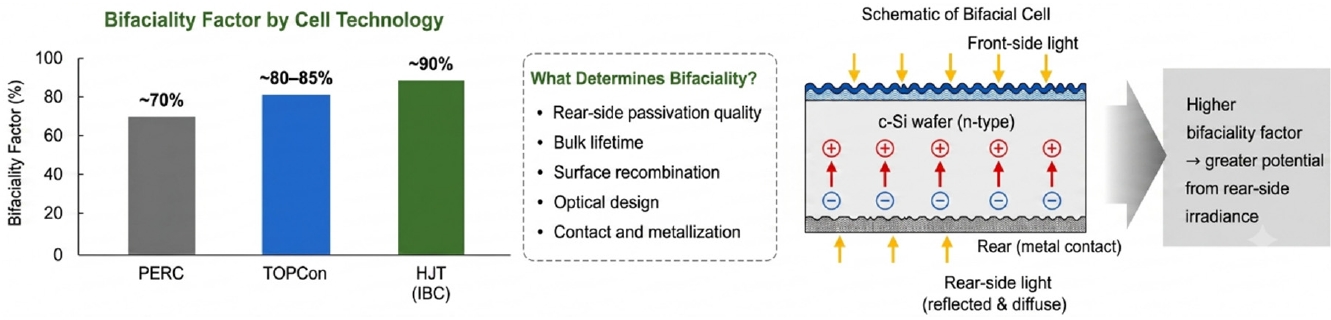
Fig. 3.Effect of ground albedo (ρ) on rear-side irradiance and bifacial gain in bifacial photovoltaic systems. The red curve represents the increase in rear-side irradiance relative to front-side irradiance, while the blue curve indicates the corresponding bifacial gain compared with conventional monofacial systems. Both rear-side irradiance and bifacial gain increase progressively with albedo, demonstrating that high-reflectivity surfaces significantly enhance rear-side energy collection and overall system performance. The results highlight the importance of ground conditions in optimizing the energy yield of bifacial PV installations, Reprinted with permission from Ref. [
12-
15]
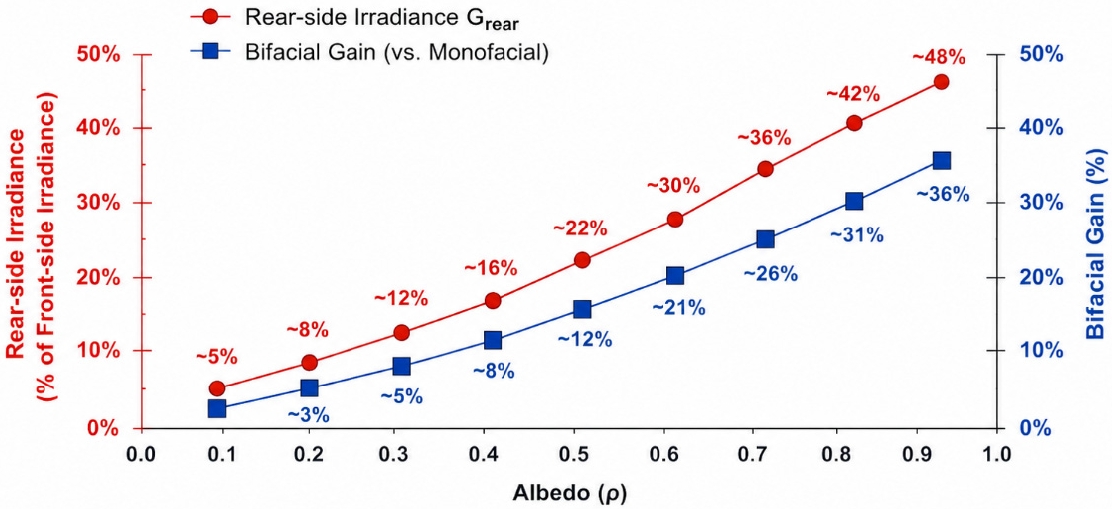
Fig. 4.Comparison of 1P (one-portrait) and 2P (two-portrait) single-axis tracker configurations, illustrating the influence of installation height and rear-side visibility on bifacial irradiance and energy yield. The 1P structure provides higher elevation and improved rear irradiance conditions, leading to greater bifacial gain, whereas the 2P structure exhibits reduced rear visibility and potential shading effects
References
- 1. H. G. Park and J. Yi, J. Korean Inst. Electr. Electron. Mater. Eng., 37, 439 (2024). doi: https://doi.org/10.4313/JKEM.2024.37.4.12
- 2. H. G. Park, J. H. Lee, and J. Yi, J. Korean Inst. Electr. Electron. Mater. Eng., 37, 582 (2024). doi: https://doi.org/10.4313/JKEM.2024.37.6.2
- 3. H. G. Park and J. Yi, J. Korean Inst. Electr. Electron. Mater. Eng., 37, 337 (2024). doi: https://doi.org/10.4313/JKEM.2024.37.3.16
- 4. H. G. Park, D. Y. Kim, and J. Yi, J. Korean Inst. Electr. Electron. Mater. Eng., 37, 133 (2024). doi: https://doi.org/10.4313/JKEM.2024.37.2.2
- 5. P. C. Madara, H. Yousuf, M. A. Zahid, S. K. Dhungel, Y. K. Kim, and J. Yi, J. Korean Inst. Electr. Electron. Mater. Eng., 37, 154 (2024). doi: https://doi.org/10.4313/JKEM.2024.37.2.5
- 6. S. Hwang, H. S. Lee, and Y. Kang, Energy Rep., 9, 3148 (2023). doi: https://doi.org/10.1016/j.egyr.2023.02.011
- 7. C. Molto, J. Oh, F. I. Mahmood, M. Li, P. Hacke, F. Li, R. Smith, D. Colvin, M. Matam, C. DiRubio, G. Tamizhmani, and H. Seigneur, Energy Technol., 11, 2200943 (2023). doi: https://doi.org/10.1002/ente.202200943
- 8. C. D. Rodriguez-Gallegos, O. Gandhi, S. K. Panda, and T. Reindl, IEEE J. Photovoltaics, 10, 1474 (2020). doi: https://doi.org/10.1109/JPHOTOV.2020.3006994
- 9. E. M. Tonita, C. E. Valdivia, A. C. J. Russell, M. Martinez-Szewczyk, M. I. Bertoni, and K. Hinzer, Joule, 7, 5 (2023). doi: https://doi.org/10.1016/j.joule.2022.12.005
- 10. J. C. Blakesley, R. S. Bonilla, M. Freitag, A. M. Ganose, N. Gasparini, P. Kaienburg, G. Koutsourakis, J. D. Major, J. Nelson, N. K. Noel, B. Roose, J. S. Yun, S. Aliwell, P. P. Altermatt, T. Ameri, V. Andrei, A. Armin, D. Bagnis, J. Baker, H. Beath, M. Bellanger, P. Berrouard, J. Blumberger, S. A. Boden, H. Bronstein, M. J. Carnie, C. Case, F. A. Castro, Y. M. Chang, E. Chao, T. M. Clarke, G. Cooke, P. Docampo, K. Durose, J. R. Durrant, M. R. Filip, R. H. Friend, J. M. Frost, E. A. Gibson, A. J. Gillett, P. Goddard, S. N. Habisreutinger, M. Heeney, A. D. Hendsbee, L. C. Hirst, M. S. Islam, K. D. G. I. Jayawardena, M. B. Johnston, M. Kauer, J. Kettle, J. S. Kim, D. Lamb, D. Lidzey, J. Lim, R. MacKenzie, N. Mason, I. McCulloch, K. P. McKenna, S. B. Meier, P. Meredith, G. Morse, J. D. Murphy, C. Nicklin, P. Ortega-Arriaga, T. Osterberg, J. B. Patel, A. Peaker, M. Riede, M. Rush, J. W. Ryan, D. O. Scanlon, P. J. Skabara, F. So, H. J. Snaith, L. Steier, J. Thiesbrummel, A. Troisi, C. Underwood, K. Walzer, T. Watson, J. M. Walls, A. Walsh, L. D. Whalley, B. Winchester, S. D. Stranks, and R. L. Z. Hoye, J. Phys. Energy, 6, 041501 (2024). doi: https://doi.org/10.1088/2515-7655/ad7404
- 11. L. Burnham, D. Riley, B. Walker, and J. M. Pearce, Proc. 2019 IEEE 46th Photovoltaic Specialists Conference (PVSC) (IEEE, Chicago, IL, USA, 2019) pp. 1320–1327. doi: https://doi.org/10.1109/PVSC40753.2019.8980964
- 12. X. Sun, M. R. Khan, C. Deline, and M. A. Alam, Appl. Energy, 212, 1601 (2018). doi: https://doi.org/10.1016/j.apenergy.2017.12.041
- 13. S. Tsuchida, Y. Tsuno, D. Sato, T. Oozeki, and N. Yamada, IEEE J. Photovoltaics, 13, 938 (2023). doi: https://doi.org/10.1109/JPHOTOV.2023.3317970
- 14. J. Hofer, A. Groenewolt, P. Jayathissa, Z. Nagy, and A. Schlueter, Energy Sci. Eng., 4, 134 (2016). doi: https://doi.org/10.1002/ese3.115
- 15. B. Marion, S. MacAlpine, C. Deline, A. Asgharzadeh, F. Toor, D. Riley, J. Stein, and C. Hansen, Proc. 2017 IEEE 44th Photovoltaic Specialist Conference (PVSC) (IEEE, Washington, DC, USA, 2017) pp. 1537–1542. doi: https://doi.org/10.1109/PVSC.2017.8366263
- 16. M. Bolinger and G. Bolinger, IEEE J. Photovoltaics, 12, 589 (2022). doi: https://doi.org/10.1109/JPHOTOV.2021.3136805
- 17. D. Keiner, L. Walter, D. Bogdanov, I. M. Peters, and C. Breyer, Sol. Energy, 295, 113543 (2025). doi: https://doi.org/10.1016/j.solener.2025.113543
- 18. S. A. Pelaez, C. Deline, P. Greenberg, J. S. Stein, and R. K. Kostuk, IEEE J. Photovoltaics, 9, 715 (2019). doi: https://doi.org/10.1109/jphotov.2019.2892872
- 19. WAAREE, The Role of Solar Trackers in Maximizing Energy Yield (Jan. 13, 2025) https://shop.waaree.com/blog/the-roleof-solar-trackers-in-maximizing-energy-yield/
- 20. J. Shah, Solar Trackers: Poised to boom with solar once again (SAUR ENERGY, Jul. 28, 2022) https://www.saurenergy.com/solar-energy-blog/solar-tracker-poised-to-boom-with-solaronce-again
- 21. Global Market Insights, Solar Tracker Market Size & Share 2026-2035 (May 2026) https://www.gminsights.com/industry-analysis/solar-tracker-market-report
- 22. L. Sun and J. Bai, Sol. Energy, 298, 113731 (2025). doi: https://doi.org/10.1016/j.solener.2025.113731
- 23. S. A. Pelaez, C. Deline, J. S. Stein, B. Marion, K. Anderson, and M. Muller, Proc. 2019 IEEE 46th Photovoltaic Specialists Conference (PVSC) (IEEE, Chicago, IL, USA, 2019), doi: https://doi.org/10.1109/PVSC40753.2019.9198975
- 24. P. Hacke, C. Molto, D. Colvin, R. Smith, F. I. Mahmood, F. Li, J. Oh, G. Tamizhmani, and H. Seigneur, EPJ Photovoltaics, 16, 16 (2025). doi: https://doi.org/10.1051/epjpv/2025004
- 25. Q. Wei, C. Wu, X. Liu, S. Zhang, F. Qian, J. Lu, W. Lian, and P. Ni, Energy Procedia, 92, 750 (2016). doi: https://doi.org/10.1016/j.egypro.2016.07.054
- 26. E. Urrejola, F. Valencia, E. Fuentealba, C. Deline, S. A. Pelaez, J. Meydbray, T. Clifford, R. Kopecek, and J. S. Stein, bifiPV2020 Bifacial Workshop: A Technology Overview (National Renewable Energy Laboratory, Golden, CO, USA, 2020), doi: https://doi.org/10.2172/1710156
- 27. W. Wu, J. Bao, L. Ma, C. Chen, R. Liu, Z. Qiao, J. Chen, and Z. Liu, Proc. EU PVSEC 2019, pp. 100-102 (2019) doi: https://doi.org/10.4229/EUPVSEC20192019-2BP.1.5