ABSTRACT
Ocean waves are not only a sustainable renewable energy source but also provide valuable information for monitoring marine environments and natural hazards. In this study, we developed a CNT/SEBS-based self-powered marine monitoring sensor utilizing a mechano-electrochemical mechanism, enabling simultaneous ultralow-frequency wave sensing and electrical energy harvesting. The developed sensor generated an open-circuit voltage of up to 60 mV and a short-circuit current of 80 μA/cm2 without an external power source by exploiting variations in electrical double-layer capacitance induced by changes in the electrode–electrolyte interface. The capacitance increased from 0.1 μF to 2.4 μF with increasing immersion area, demonstrating the effectiveness of the proposed sensing mechanism. Furthermore, the CNT/SEBS bilayer exhibited high electrical conductivity together with excellent stretchability and flexibility, maintaining stable electrical responses under repeated water-level fluctuations. The proposed mechano-electrochemical self-powered sensor provides a promising platform for next-generation autonomous marine monitoring systems and sustainable blue-energy harvesting technologies.
-
KEYWORDS: CNT, SEBS, Mechano-electrochemical energy harvester, Ocean wave monitoring, Self-powered sensor
1 Introduction
Mechanical energy generated by ocean waves and currents contains abundant environmental information, making it a valuable resource for monitoring marine conditions and providing early warning of natural hazards such as tsunamis [
1–
3]. Wave-monitoring technologies have therefore attracted significant attention for a wide range of marine applications, including tidal observation, fisheries, marine life tracking, earthquake and tsunami early-warning systems, underwater navigation, sonar, and oceanographic research [
3].
Considerable efforts have been devoted to the development of sensors capable of monitoring ultralow-frequency ocean waves [
4–
6]. Various sensing mechanisms have been explored, each offering distinct advantages and limitations for marine applications. On land, the Global Positioning System (GPS) is widely employed to detect geological instabilities, such as ground deformation, rock displacement, and crustal uplift. However, because GPS relies on microwave-frequency signals that are strongly attenuated in water, it is unsuitable for monitoring underwater or sea-surface dynamics [
4].
Resistive and capacitive sensors are among the most widely used technologies for marine monitoring [
5,
6]. Nevertheless, these sensors require an external power supply, which significantly limits their long-term deployment in remote marine environments. Since monitoring devices are often distributed over vast ocean areas where maintenance, battery replacement, and recharging are impractical, self-powered sensing technologies capable of harvesting ambient energy have emerged as an attractive alternative. Piezoelectric and triboelectric sensors have demonstrated high sensitivity as self-powered sensing platforms [
7,
8]. However, practical marine applications require waterproof encapsulation to prevent water penetration, which inevitably reduces sensitivity to underwater mechanical stimuli. Moreover, the output performance of these devices deteriorates rapidly at frequencies below approximately 2 Hz, making them unsuitable for detecting ocean-wave motions occurring in the ultralow-frequency regime (<10
-2 Hz). Consequently, reliable sensing of slow underwater mechanical motions remains a significant technological challenge.
Recently, our group reported a mechano-electrochemical energy harvester that generates electrical energy through changes in electrochemical potential induced by variations in the immersion area of an electrode in an electrolyte [
9–
13]. In this system, electricity is generated by modulating the electrical double-layer capacitance at the electrode–electrolyte interface without requiring an external power source. However, previously reported carbon nanotube (CNT) forest electrodes suffer from several practical limitations, including relatively low electrical conductivity, high fabrication cost, and limited scalability to large-area devices.
Here, we report a new mechano-electrochemical energy harvester based on a spray-coated carbon nanotube (CNT)/styrene–ethylene– butylene–styrene (SEBS) bilayer electrode. The spray-coating process enables scalable fabrication over large areas while providing excellent mechanical compliance, including a low Young's modulus and high stretchability imparted by the elastomeric SEBS substrate. The proposed electrode autonomously generates electrical energy by exploiting capacitance variations arising from changes in the electrode–electrolyte contact area, thereby providing a simple, scalable, and highly compliant platform for self-powered marine wave sensing.
2 Experiment
2.1 Fabrication of CNT/SEBS Bilayer Electrode
The carbon nanotube (CNT)/styrene–ethylene–butylene–styrene (SEBS) bilayer was fabricated using commercially available CNT powder (Sigma Aldrich, USA) with a diameter of 6–13 nm and a length of 2.5–25 μm and SEBS elastomer (Sigma Aldrich, USA). First, CNT powder (0.1 wt%) was dispersed in an aqueous solution containing 1 wt% sodium dodecylbenzenesulfonate (SDBS) as a surfactant. The resulting CNT dispersion (10 mL) was spray-coated onto a polytetrafluoroethylene (PTFE) film (20 × 20 cm) using a spray gun, followed by drying in an oven at 60°C for 3 h. Subsequently, SEBS (4 wt%) was dissolved in chloroform under magnetic stirring for 24 h. The prepared SEBS solution (10 mL) was then spray-coated onto the CNT layer. To obtain a uniform elastomer coating, the spray-coating process was repeated five times. After complete drying, the freestanding CNT/SEBS bilayer film was readily peeled from the PTFE substrate owing to the low interfacial adhesion between the film and the PTFE surface.
2.2 Characterization and Electrochemical Measurements
The electrochemical performance of the fabricated electrodes was evaluated using a potentiostat/galvanostat (Gamry G750, Gamry Instruments, USA). Electrochemical measurements were carried out in a conventional three-electrode configuration consisting of the fabricated CNT/SEBS electrode as the working electrode, a platinum mesh as the counter electrode, and an Ag/AgCl electrode as the reference electrode.
A CNT/SEBS electrode (1 × 5.0 cm) was connected to an electromagnetic motor, and the immersion depth was precisely controlled using a custom-programmed motorized stage to simulate periodic water-level fluctuations. Measurements were performed in a 0.6 M NaCl aqueous solution (~3 wt%), corresponding to the salinity of seawater, at a constant temperature of 30°C. The system enabled periodic immersion and emersion over a frequency range of 0.01–1 Hz, while the water-level displacement could be adjusted with a minimum step size of 0.2 cm.
The CV measurements were performed at a scan rate of 10 mV s⁻¹. The capacitance was calculated from the cyclic voltammetry (CV) curves using the following equation:
where C is capacitance, I dis is discharge current, A CV curve is area of CV curve, dV /dt is the scan rate and E is the potential range of the CV curve.
The surface morphology of the samples was characterized using field-emission scanning electron microscopy (FESEM; Hitachi S-4700, Japan) operated at an accelerating voltage of 15 kV. Electrical characteristics were measured using a digital multimeter (Model 187, Fluke Corporation, USA). Mechanical properties were evaluated using a universal testing machine (UTM; Instron 5966, Instron, USA).
3 Result and Discussion
3.1 Ocean Monitoring Sensor Using Mechano-Electrochemical Energy Harvester
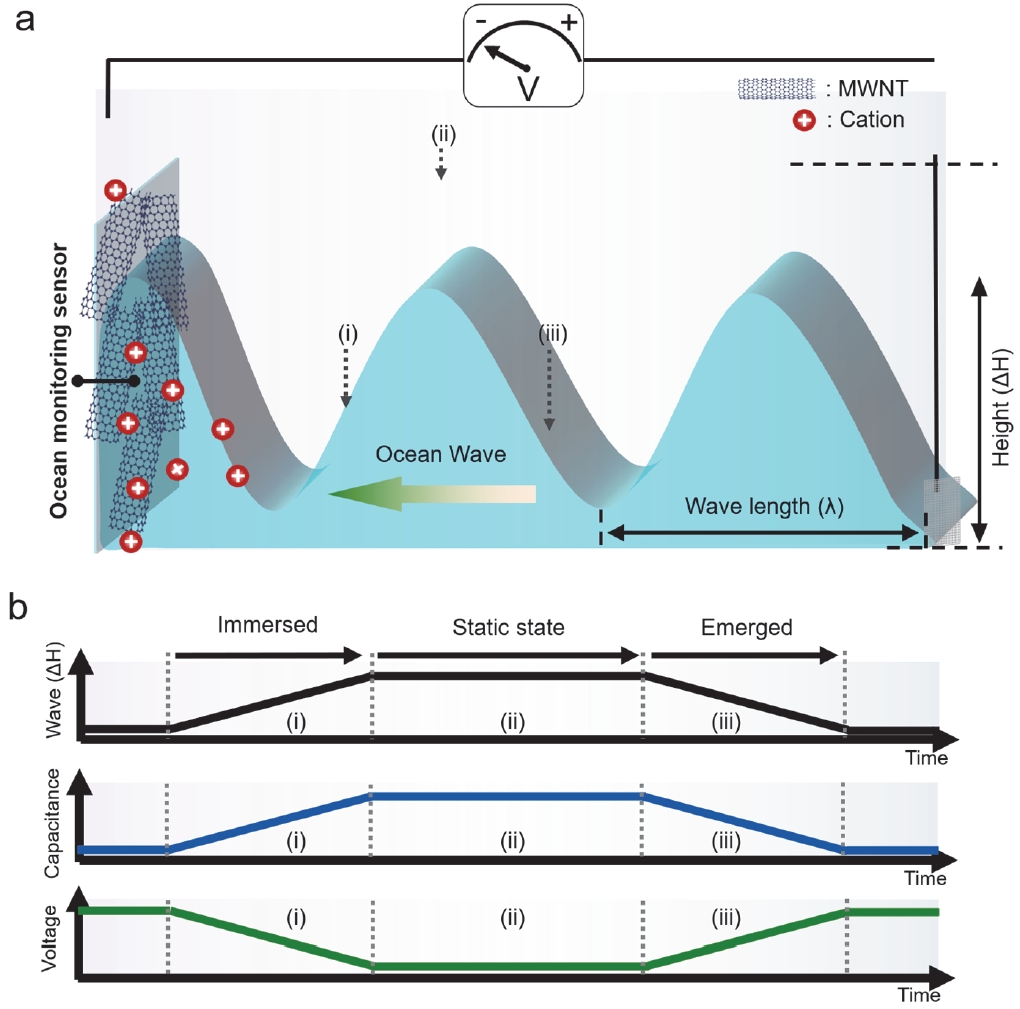
The operating principle of the mechano-electrochemical (MECH) self-powered sensor is based on changes in the electrochemical capacitance and potential difference induced by variations in the electrode–electrolyte interface [
Fig. 1(a)]. As the contact area between the electrode and the electrolyte increases, the capacitance of the electrical double layer (EDL) correspondingly increases, resulting in the generation of electrical energy [
Fig. 1(b)]. In addition, owing to the slow ion diffusion kinetics at the electrode–electrolyte interface, a continuous current is generated under static conditions, with its magnitude proportional to the immersed electrode area [
12]. This behavior is fundamentally different from that of conventional piezoelectric and triboelectric generators, which produce transient electrical outputs with millisecond-scale pulse widths only during dynamic mechanical deformation. Consequently, the proposed sensor is capable of detecting both dynamic and static mechanical motions without requiring an external power source.
The sensor enables real-time monitoring of both artificially generated waves and naturally occurring ocean waves by converting water-level fluctuations into time-dependent voltage signals. Furthermore, its ability to respond to ultralow-frequency mechanical motions makes it particularly suitable for detecting waveforms associated with natural hazards, including tsunamis and earthquakes.
3.2 The morphology and Characteristic of CNT/SEBS Bilalyer
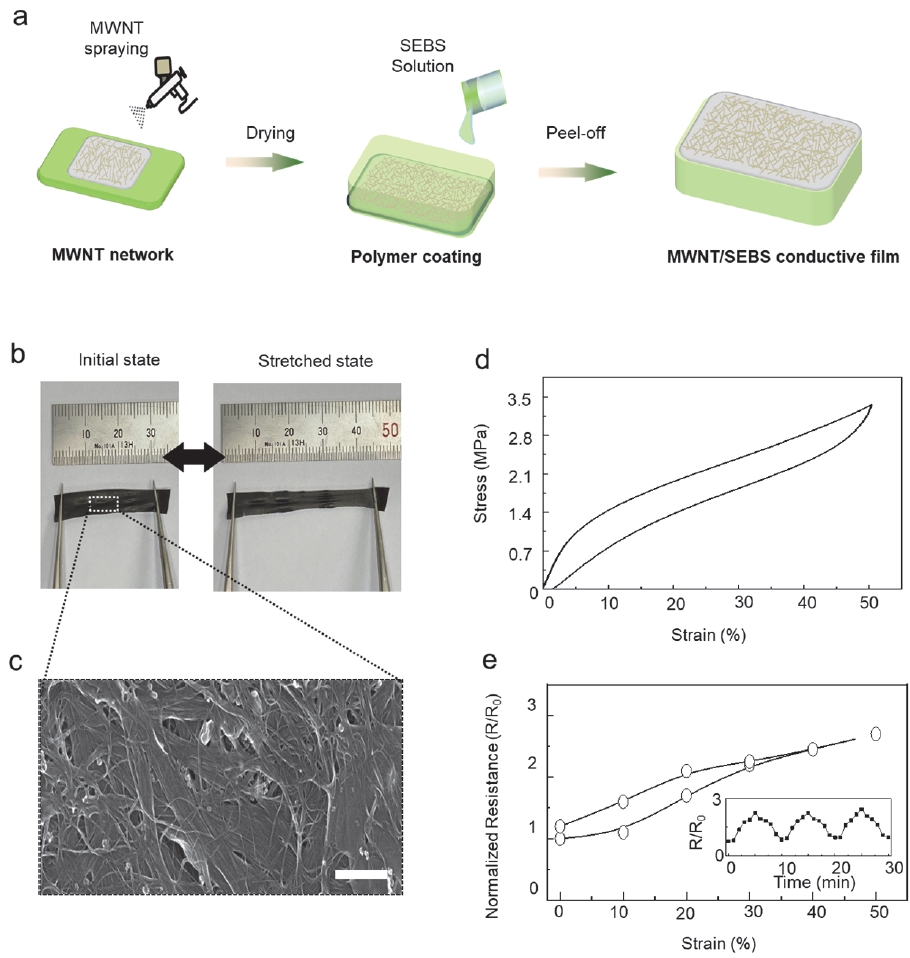
The CNT/SEBS bilayer was fabricated by sequential spray coating of an aqueous CNT dispersion and an SEBS solution, as illustrated in
Fig. 2(a). Spray coating is a scalable and continuous fabrication process that is well suited for large-area manufacturing and industrial-scale production. Using this process, a freestanding bilayer film with dimensions of 20 × 20 cm and a thickness of approximately 30 μm was successfully fabricated [
Fig. 2(b)]. In addition, spray coating enables precise patterning through the use of masks, allowing various electrode geometries, such as grid and serpentine patterns, to be readily produced.
Interestingly, the fabricated bilayer simultaneously exhibited high electrical conductivity, excellent elasticity, and outstanding mechanical flexibility owing to its unique bilayer architecture. Unlike conventional homogeneous CNT/polymer composites, the bilayer exhibited a relatively low sheet resistance of 3.7 kΩ sq
-1 despite containing less than 5 wt% CNT. This performance originates from the sequential coating process, in which the conductive CNT layer and the elastomeric SEBS layer remain physically separated, enabling the CNTs to form an interconnected conductive network [
Fig. 2(c)]. The CNTs are mechanically entangled through van der Waals interactions, resulting in a freestanding conductive film that provides efficient electron transport pathways. Furthermore, because the CNT layer is directly exposed to the electrolyte, it offers a large electrochemically active surface area for interfacial reactions. In contrast, the SEBS layer retains its intrinsic elasticity and flexibility because it is not rigidified by CNT incorporation. Consequently, the bilayer combines excellent flexibility, high stretchability, and an ultrathin thickness of approximately 30 μm, allowing conformal contact with curved surfaces while minimizing mechanical discomfort. Owing to the high SEBS content, the bilayer also exhibited a low areal mass density of 2.5 mg cm
-2 and a bulk density of 0.8 g cm
-3, comparable to that of pristine SEBS, demonstrating its lightweight characteristics.
The fabricated bilayer also exhibited excellent mechanical compliance suitable for deformable electrode applications. As shown in
Fig. 2(d), the bilayer sustained a tensile strain of 50% while generating a stress of 2.7 MPa, and repeatedly recovered its original shape after cyclic stretching. In practical marine environments, wave-induced motion continuously subjects the sensor to tensile and bending deformation. Conventional electrodes with limited stretchability are susceptible to mechanical failure or irreversible degradation under such conditions. In contrast, the CNT/SEBS bilayer exhibited a remarkably low Young's modulus of 5.5 MPa, approximately two orders of magnitude lower than that of conventional harvesting electrodes, enabling the device to readily accommodate environmental deformation while maintaining mechanical integrity under repeated tensile loading.
The bilayer also maintained excellent electrical conductivity during mechanical deformation. To evaluate its electromechanical stability, a CNT/SEBS strip (0.5 × 4 × 30 μm) was mounted on a digital caliper, and the electrical resistance was measured as a function of tensile strain. As the strain increased to 50%, the normalized resistance (R/R₀) gradually increased to approximately 2.8 [
Fig. 2(e)]. Upon releasing the applied strain, the resistance recovered almost completely to its initial value as the sample returned to its original dimensions. This reversible electromechanical behavior originates from the conductive CNT network embedded within the bilayer. During stretching, the contact between adjacent CNTs decreases and some conductive junctions are partially separated, reducing the effective contact area and increasing the electron transport pathway, thereby increasing the electrical resistance. When the applied strain is released, the elastomeric SEBS matrix restores the CNT network, re-establishing conductive pathways and recovering the initial resistance. Consequently, the CNT/SEBS bilayer exhibited stable and reproducible electrical responses during repeated stretching and relaxation cycles, demonstrating its suitability for flexible and stretchable self-powered marine sensing applications.
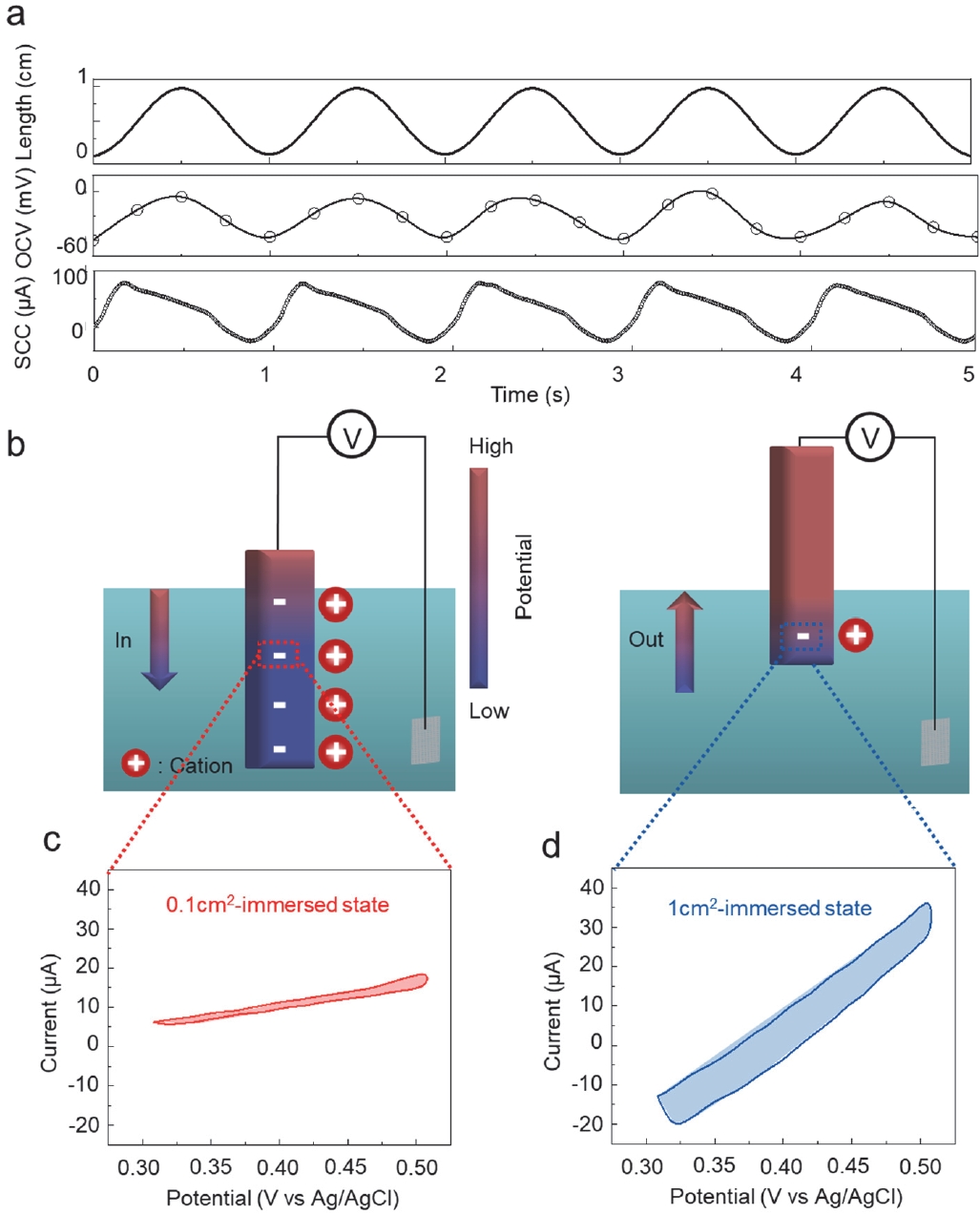
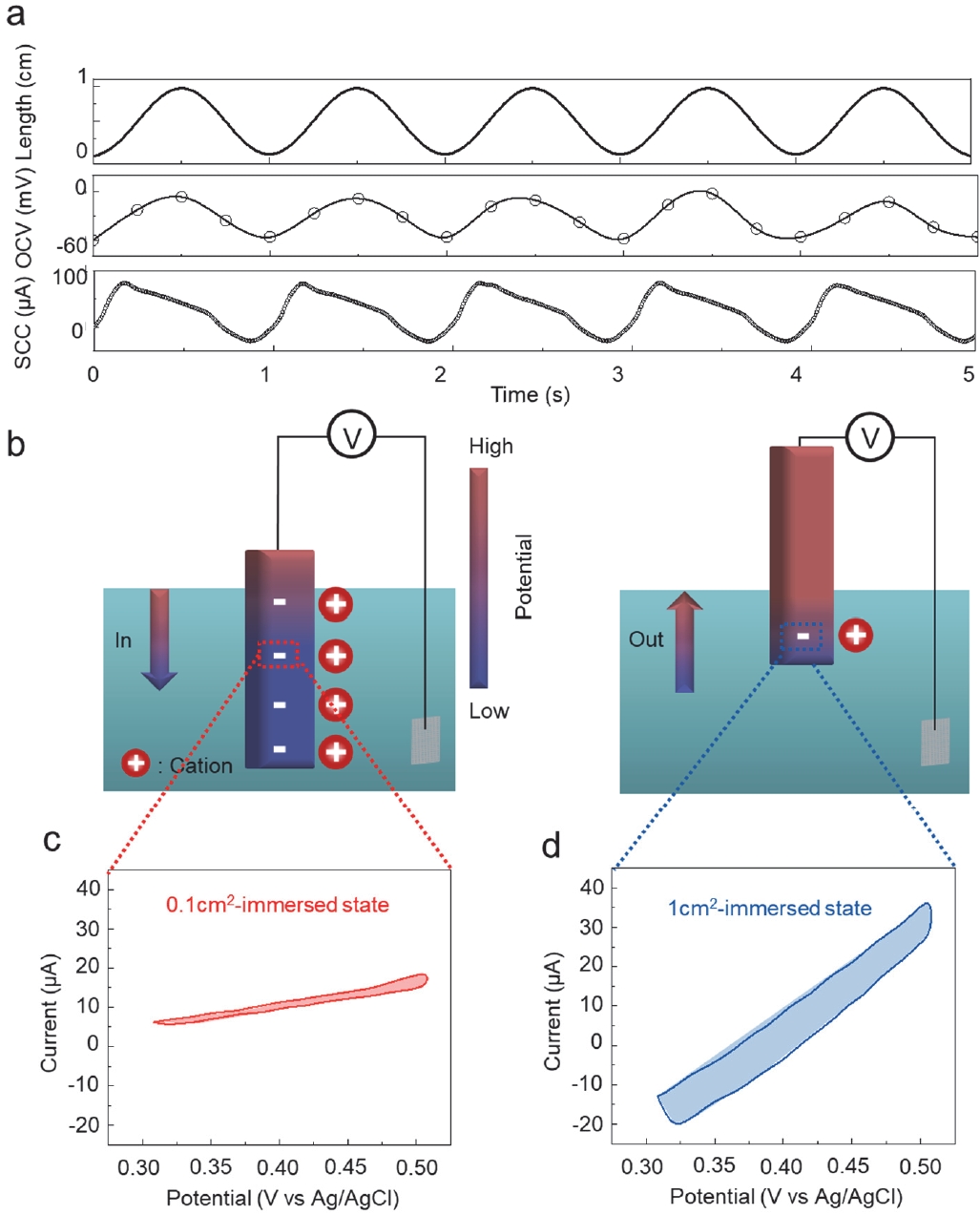
A sensor that generates electrical energy in response to changes in water level can function simultaneously as a wave-energy harvester and a self-powered wave sensor. To evaluate this capability, the electrochemical characteristics of the sensor were investigated using a three-electrode system consisting of the CNT/SEBS electrode as the working electrode, a platinum electrode as the counter electrode, and an Ag/AgCl electrode as the reference electrode [
Fig. 3(a)]. An electrode with a width of 1 cm and a length of 5 cm was immersed in a 0.6 M NaCl aqueous solution to simulate a marine environment. A sinusoidal change in immersion depth with an amplitude of 1 cm was applied at a frequency of 1 Hz.
As the immersed area of the electrode periodically changed in the electrolyte, electrical energy was generated in proportion to the variation in the electrode–electrolyte contact area. When the electrode was nearly fully immersed and an area of approximately 1 cm² was in contact with the electrolyte, the open-circuit voltage change (ΔOCV) reached approximately −60 mV. As the immersed area decreased, the electrode potential repeatedly recovered to its initial value. Simultaneously, the short-circuit current (SCC) varied in response to changes in the electrode–electrolyte interface, reaching a maximum value of approximately 80 μA/cm
2. When the CNT/SEBS electrode is immersed in the electrolyte, electrochemical interactions at the electrode–electrolyte interface lead to the development of an equilibrium interfacial potential. Consequently, a potential difference is established between the CNT/SEBS electrode and the Pt counter electrode, resulting in the initial potential observed upon immersion. This initial potential difference has been referred to as the “intrinsic voltage” in previous studies [
11,
12].
The electricity-generation mechanism induced by changes in the immersed surface area can be explained by the coupling between the electrochemical capacitance and the electrode potential [
Fig. 3(b)]. When the electrode is immersed in the electrolyte, a chemical-potential difference develops across the electrode–electrolyte interface, causing ions to adsorb onto the CNT surface and form an electrical double layer. As the contact area between the sensor electrode and the electrolyte increases, the electrochemical capacitance correspondingly increases. For example, at an immersed area of 0.1 cm², the capacitance was approximately 0.1 μF, corresponding to 0.004 F kg
-1 [
Fig. 3(c)]. When the immersed area increased to 1.0 cm
2, the capacitance increased to approximately 2.4 μF, corresponding to 0.08 F kg
-1 [
Fig. 3(d)]. This increase results from the larger electrode surface area available for ion adsorption at greater immersion depths. Accordingly, the variation in electrochemical capacitance induces a change in the electrode potential according to the relationship Q = CV, thereby providing the fundamental mechanism for electrical energy generation. The capacitance of CNT/SEBS electrodes does not necessarily increase linearly with the immersed area because electrolyte infiltration into the rough and porous CNT network can activate additional ion-accessible internal surfaces.
In previously reported energy-harvesting systems based on capacitance variation, an external bias voltage was generally required to establish the electrochemical capacitance. Such an approach not only increases the device volume and system complexity but also requires continuous maintenance, including periodic charging or replacement of the power source. In contrast, the present sensor generates an intrinsic bias potential associated with the open-circuit potential of the CNT electrode. Consequently, it can continuously produce electrical energy without an external power supply, making it particularly suitable for energy harvesting and environmental monitoring in remote or difficult-to-access marine environments.
4 Conclusion
In summary, the proposed self-powered sensor demonstrates significant potential as both an ultralow-frequency energy harvester and a self-powered wave monitoring system. The device efficiently converts the mechanical motion of ocean waves into electrical energy through electrochemical interactions at the CNT–electrolyte interface. Unlike conventional piezoelectric and triboelectric energy harvesters, whose performance deteriorates under ultralow-frequency excitation, the proposed sensor exhibits distinct advantages in the frequency regime below 1 Hz, enabling reliable operation for slowly varying ocean waves.
The spray-coated CNT electrode maximizes the electrochemically active surface area while maintaining excellent flexibility and stretchability, allowing stable energy conversion under repeated mechanical deformation. Consequently, the sensor provides accurate, real-time monitoring of ocean waves without signal distortion, even under complex environmental conditions. Experimental results demonstrate that the device can faithfully detect and analyze slow and complex waveforms, highlighting its capability for monitoring natural phenomena associated with ultralow-frequency waves, such as tsunamis and seismic sea waves. Furthermore, the generated electrical energy can be directly stored and repeatedly utilized without the need for an external power source, extending the applicability of the system beyond environmental monitoring to self-powered electronics and low-power autonomous devices. Owing to its excellent scalability, mechanical robustness, and adaptability to diverse marine environments, the proposed mechano-electrochemical self-powered sensor represents a promising platform for sustainable blue-energy harvesting and long-term environmental monitoring in remote and inaccessible locations.
Notes
-
Acknowledgement
This research was supported by the Regional Innovation System & Education (RISE) program through the (Chungbuk Regional Innovation System & Education Center), funded by the Ministry of Education (MOE) and the (Chungcheongbuk-do), Republic of Korea (2026-RISE-11-003-03) and by the National Research Foundation of korea (NRF) grant funded by the Korea government (MSIT) (No.NRF-RS-2024-00449455).
-
Conflict of Interest
The authors have no conflicts of interest to declare.
-
Author Contributions
Seokkan Ki: Conceptualization, Data curation.
Junyoung Lee: Visualization, Validation, Formal analysis.
Hyeon Jun Sim: Conceptualization, Writing - Original Draft, Writing - Review & Editing.
Data Availability
Data available on request from the authors
Fig. 1.(a) Schematic illustration of the self-powered marine monitoring system based on the mechano-electrochemical sensing mechanism. (b) Schematic showing the changes in electrical double-layer capacitance and electrochemical potential as a function of the electrode immersion depth in the electrolyte
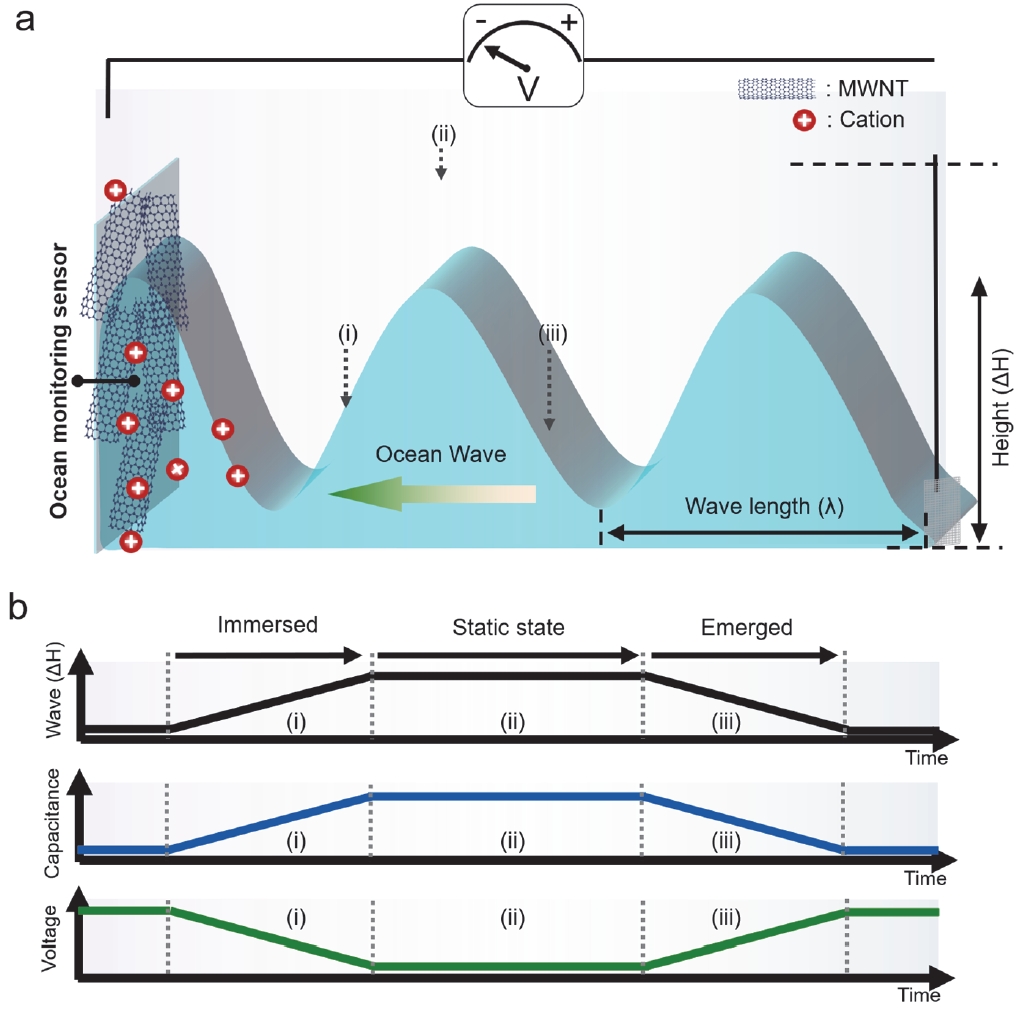
Fig. 2.(a) Schematic illustration of the fabrication process of the CNT/SEBS bilayer electrode. (b) Photographs of the CNT/SEBS bilayer under tensile deformation and (c) SEM image of the bilayer structure (scale bar :500 nm). (d) Tensile stress–strain curve and (e) normalized electrical resistance (R/R₀) of the CNT/SEBS bilayer as a function of applied tensile strain
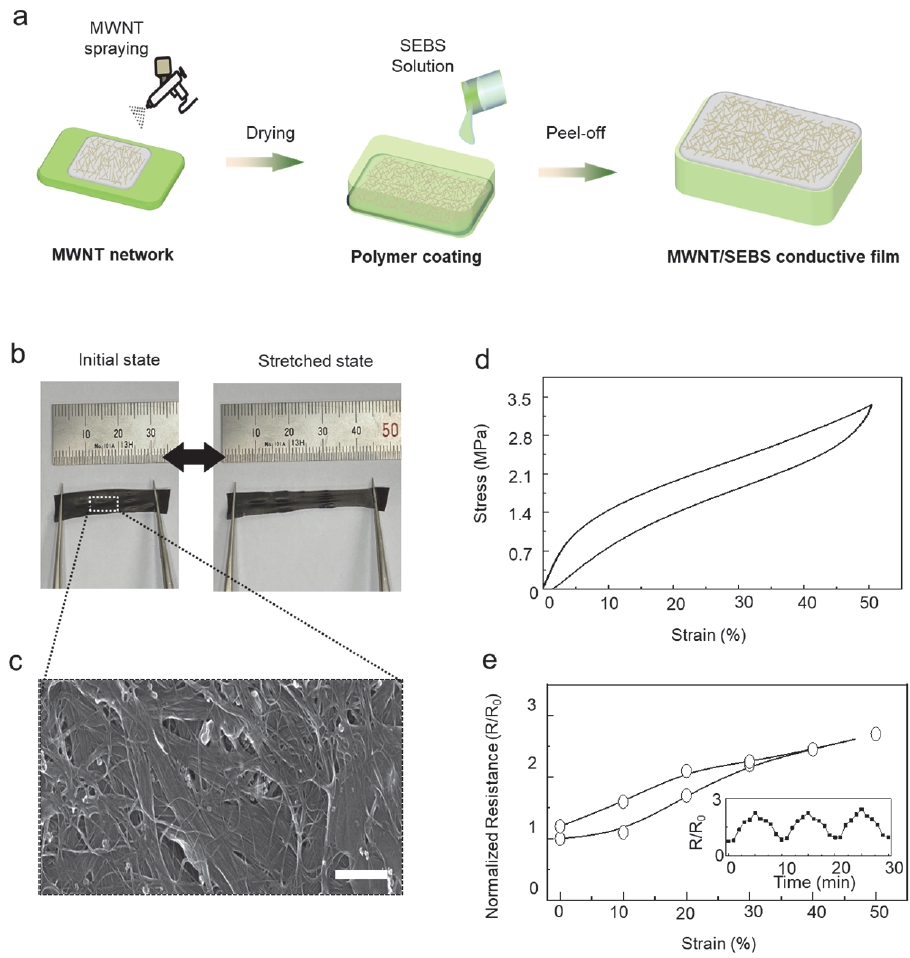
Fig. 3.(a) Open-circuit voltage and short-circuit current generated during cyclic immersion of the CNT/SEBS electrode. (b) Schematic illustration of the mechano-electrochemical energy-harvesting mechanism. Cyclic voltammetry (CV) curves of the CNT/SEBS electrode at an immersed area of (c) 0.1 cm2 and (d) 1.0 cm2 at scan rate of 10 mV/s, showing the increase in electrochemical capacitance with increasing electrode–electrolyte contact area
References
- 1. L. Henry, J. Bridge, M. Henderson, K. Keleher, M. Barry, G. Goodwin, D. Namugayi, M. Morris, D. Oaks, D. Dalrymple, S. Shrake, A. Ota, L. Azevedo, B. Blue, Z. Boucher, S. Boege, L. Hager, T. Mack, K. Thompson, D. Rodak, B. Harding, B. Liu, S. Zhu, J. Loveall, and M. Chavez, Renew. Sustain. Energy Rev., 50, 160 (2015). doi: https://doi.org/10.1016/j.rser.2015.04.115
- 2. K. Masuda, S. Ide, K. Ohta, and T. Matsuzawa, Earth Planets Space, 72, 47 (2020). doi: https://doi.org/10.1186/s40623-020-01172-8
- 3. H. J. Sim, D. Y. Lee, H. Gwac, S. Lee, J. Jeon, S. J. Kim, Y. K. Kim, C. S. Kim, Y. J. Kim, S. Kwon, and C. Choi, Advanced Science, 12, 2503578 (2025). doi: https://doi.org/10.1002/advs.202503578
- 4. W. Freda, K. Haule, and S. Sagan, Ocean Sci., 15, 745 (2019). doi: https://doi.org/10.5194/os-15-745-2019
- 5. Y. Yu. Yurovsky and V. A. Dulov, Ocean Eng., 217, 108043 (2020). doi: https://doi.org/10.1016/j.oceaneng.2020.108043
- 6. P. W. Lui, B. C. Yeo, and W. S. Lim, Int. J. Adv. Sci. Eng. Inf. Techno., 13, 2098 (2023). doi: https://doi.org/10.18517/ijaseit.13.6.19045
- 7. R. Liu, L. He, X. Liu, S. Wang, L. Zhang, and G. Cheng, Sustain. Energy Technol. Assess., 59, 103417 (2023). doi: https://doi.org/10.1016/j.seta.2023.103417
- 8. C. Song, X. Zhu, M. Wang, P. Yang, L. Chen, L. Hong, and W. Cui, Sustain. Energy Technol. Assess., 53, 102767 (2022). doi: https://doi.org/10.1016/j.seta.2022.102767
- 9. H. J. Sim and C. Choi, Nano Lett., 22, 8695 (2022). doi: https://doi.org/10.1021/acs.nanolett.2c03296
- 10. J. Kim, J. H. Noh, S. Chun, S. J. Kim, H. J. Sim, and C. Choi, Nano Lett., 23, 7623 (2023). doi: https://doi.org/10.1021/acs.nanolett.3c02221
- 11. H. J. Sim, J. Kim, W. Son, J. M. Lee, D. Y. Lee, Y. J. Kim, Y. K. Kim, S. J. Kim, J. M. Oh, and C. Choi, Nano Energy, 128, 109889 (2024). doi: https://doi.org/10.1016/j.nanoen.2024.109889
- 12. H. J. Sim and C. Choi, J. Korean Inst. Electr. Electron. Mater. Eng., 38, 8 (2025). doi: https://doi.org/10.4313/JKEM.2025.38.1.2
- 13. J. M. Lee, W. Son, J. Kim, J. H. Noh, M. Oh, J. Choi, and C. Choi, J. Korean Inst. Electr. Electron. Mater. Eng., 36, 303 (2023). doi: https://doi.org/10.4313/JKEM.2023.36.4.1