ABSTRACT
Lead-free bismuth sodium titanate (BNT)-based ceramics have attracted strong attention as environmentally benign dielectric materials for high-efficiency electrostatic energy-storage capacitors. A key challenge is that pristine BNT typically exhibits large hysteresis, high remnant polarization, and limited dielectric reliability, which restrict recoverable energy storage and efficiency under practical electric fields. Here, we present a focused mini-review of recent studies to clarify how composition design, phase boundary tuning, defect chemistry, and microstructural control collectively enable slim or pinched polarization-electric field (P-E) behavior and improved energy-storage functionality in BNT-related bulk ceramics. The reviewed outcomes consistently show that stabilizing relaxor states governed by polar nanoregions (PNRs), often via solid-solution engineering and secondary relaxor/antiferroelectric-like incorporation, suppresses irreversible switching and reduces hysteresis loss, while densification and grain-size control enhance electrical homogeneity and breakdown strength. In addition, defect-mediated tuning of oxygen vacancy-related complexes is highlighted as an independent lever to control relaxor ergodicity and polarization reversibility, providing a complementary route to slim-loop optimization. These insights are expected to guide integrated design strategies that couple phase/relaxor-state engineering with defect and microstructure optimization, accelerating the development of reliable, temperature-robust, lead-free dielectric capacitors based on BNT-related ceramics.
-
KEYWORDS: Bismuth sodium titanate (BNT), Lead-free dielectric ceramics, Relaxor ferroelectrics, Polar nanoregions (PNRs), Energy-storage performance
1 Introduction
Electrostatic energy storage based on dielectric capacitors has attracted increasing attention for advanced electronic and power systems, including pulsed power devices, electric vehicles, high-frequency inverters, and microwave applications, owing to their ultrafast charge-discharge capability, excellent power density, and superior cycling stability compared with electrochemical energy storage systems [
1]. However, the relatively low energy storage density of conventional dielectric ceramics remains a major obstacle to device miniaturization and practical implementation [
2]. In this context, the development of lead-free dielectric ceramics with high recoverable energy density (W
rec) and high energy efficiency (η) has become an important research priority [
3].
Among various dielectric materials, relaxor ferroelectrics (RFEs) are particularly promising for energy storage applications because they can simultaneously exhibit high maximum polarization (P
max), low remnant polarization (P
r), and slim or pinched polarization-electric field (P-E) hysteresis loops [
4]. These characteristics originate from the presence of polar nanoregions (PNRs), which enable reversible field-induced polarization without stabilizing long-range ferroelectric order [
5]. Consequently, RFEs often deliver large W
rec with minimal hysteresis loss, in contrast to normal ferroelectrics with large P
r or antiferroelectrics with substantial energy loss and limited cycling stability [
6].
Bi
0.5Na0.5TiO
3 (BNT)-based ceramics have emerged as one of the most intensively studied lead-free RFE systems due to their high Curie temperature, strong intrinsic polarization associated with Bi
3+ lone-pair activity, and good thermal stability [
7]. Nevertheless, pristine BNT suffers from several intrinsic limitations for energy storage, including a large coercive field, high P
r, and pronounced hysteresis, which lead to poor energy efficiency and limited breakdown strength [
8]. As a result, extensive efforts have been devoted to modifying the BNT lattice through compositional design, particularly via binary or ternary solid solutions and targeted doping strategies, to suppress long-range ferroelectric order and stabilize an ergodic or weakly non-ergodic relaxor (NER) state [
9].
A widely adopted strategy involves forming BNT-based solid solutions near morphotropic or polymorphic phase boundaries, such as BNT-BaTiO
3 (BT) or BNT-(Na, K) TiO
3 systems, where phase coexistence and structural instability enhance polarization dynamics [
10]. More recently, advanced domain and phase engineering approaches have demonstrated that introducing secondary relaxor or antiferroelectric- like components, such as Bi
0.2Sr
0.7TiO
3, Sr (Zn
1/3Nb
2/3) O
3 (SZN), or layered perovskite-related phases, can effectively disrupt long-range ferroelectric domains, promote the formation of highly dynamic PNRs, and significantly reduce Pr [
11]. These compositional modifications often lead to distinctly slim P-E loops, enhanced breakdown strength, and substantially improved W
rec and η in bulk-sintered ceramics [
12].
In parallel, defect chemistry and microstructural control have been recognized as equally important factors governing the relaxor behavior and dielectric reliability of BNT-based ceramics [
13]. Asite or B-site doping can regulate oxygen vacancy concentration, random electric fields, and lattice disorder, thereby tuning the ergodic-nonergodic relaxor transition [
14]. Additionally, grain refinement, densification, and suppression of abnormal grain growth contribute to higher breakdown strength by improving electrical homogeneity and reducing local field concentration [
15]. These intrinsic and extrinsic effects collectively determine whether a BNT-based ceramic exhibits a wide, lossy hysteresis loop or a slim, energy-efficient P-E response suitable for capacitor applications [
16].
Despite rapid progress, existing studies on BNT-based energy storage ceramics are often reported in a fragmented manner, focusing on specific dopants, individual phase transitions, or isolated microstructural effects [
17]. A coherent perspective that links compositional design, relaxor state stabilization, microstructural evolution, and the resulting slim P-E behavior in bulk BNT ceramics remains necessary [
18]. In particular, recent contributions from Korean research groups have systematically demonstrated that carefully selected doping and solid-solution strategies can transform conventional BNT ceramics into high-performance relaxor dielectrics with competitive energy storage properties.
Therefore, this review focuses on recent advances in BNT-based bulk ceramics achieved through compositional and domain engineering strategies. The scope of this mini-review is limited to bulk-sintered BNT-related ceramic systems for dielectric energy-storage applications. Accordingly, thin films, multilayer structures, polymer-based composites, and multilayer ceramic capacitor (MLCC) processing/fabrication are not discussed in this paper. By critically examining six representative studies, this review highlights how targeted doping, phase boundary design, relaxor-antiferroelectric coupling, and microstructural optimization synergistically suppress Pr and enhance breakdown strength. The relationships between composition, relaxor state, polarization behavior, and energy storage performance are discussed, and remaining challenges and future directions for the rational design of high-performance BNT-based dielectric capacitors are outlined.
2 Representative Design Strategies in BNT-Based Bulk Ceramics for Energy Storage
2.1 Domain and Lattice Engineering via SZN Doping for Enhanced Energy Storage in BNT-BT Lead-Free Relaxor Ceramics
BNT-BT ceramics located near the morphotropic phase boundary have been extensively investigated as promising lead-free dielectric materials for energy storage applications due to their relatively high polarization and good thermal stability. However, conventional BNT-BT ceramics still suffer from several intrinsic drawbacks, including large P
r, limited breakdown strength, and significant hysteresis loss, which severely restrict their W
rec and energy efficiency. To address these limitations, the reported study introduces SZN as a multifunctional dopant into the BNT-BT system [
19]. The underlying strategy is that SZN doping can simultaneously induce lattice disorder, refine grain morphology, and promote the formation of PNRs, thereby suppressing long-range ferroelectric order and stabilizing relaxor ferroelectric behavior. By systematically varying the SZN content, the study aims to elucidate the relationships among phase evolution, microstructural modification, relaxor characteristics, and energy storage performance in bulk BNT-based ceramics. In pure BNT-BT ceramics, large ferroelectric domains and strong long-range ferroelectric ordering give rise to wide P-E hysteresis loops with high P
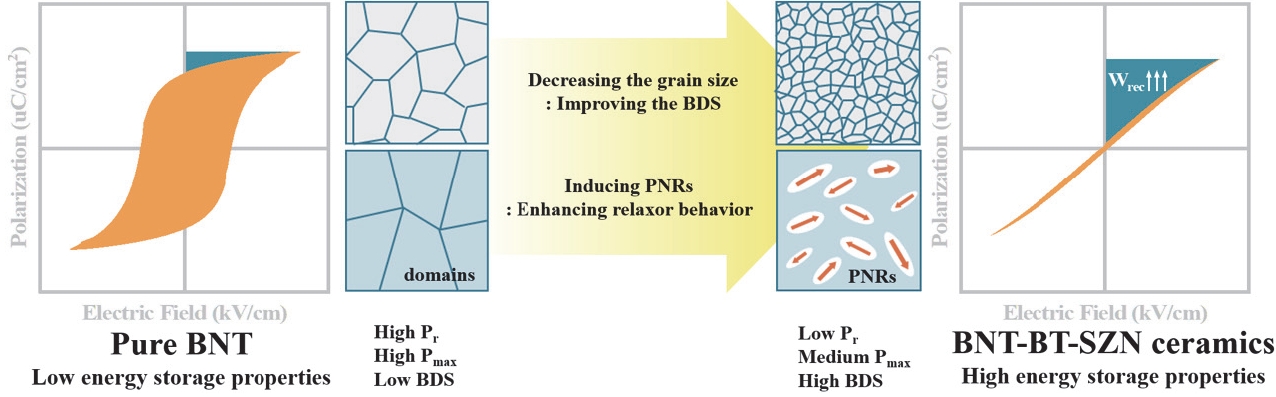
r and low breakdown strength, resulting in poor energy storage performance. In contrast, the incorporation of SZN disrupts the continuity of ferroelectric domains and induces nanoscale polar regions embedded within a weakly polar matrix. At the same time, grain refinement enhances electrical homogeneity and breakdown strength. Consequently, BNT-BT-SZN ceramics exhibit slim P-E hysteresis loops with reduced P
r, moderate P
max, and enhanced breakdown strength, which are favorable for achieving high W
rec and energy efficiency, as schematically illustrated in
Figure 1.
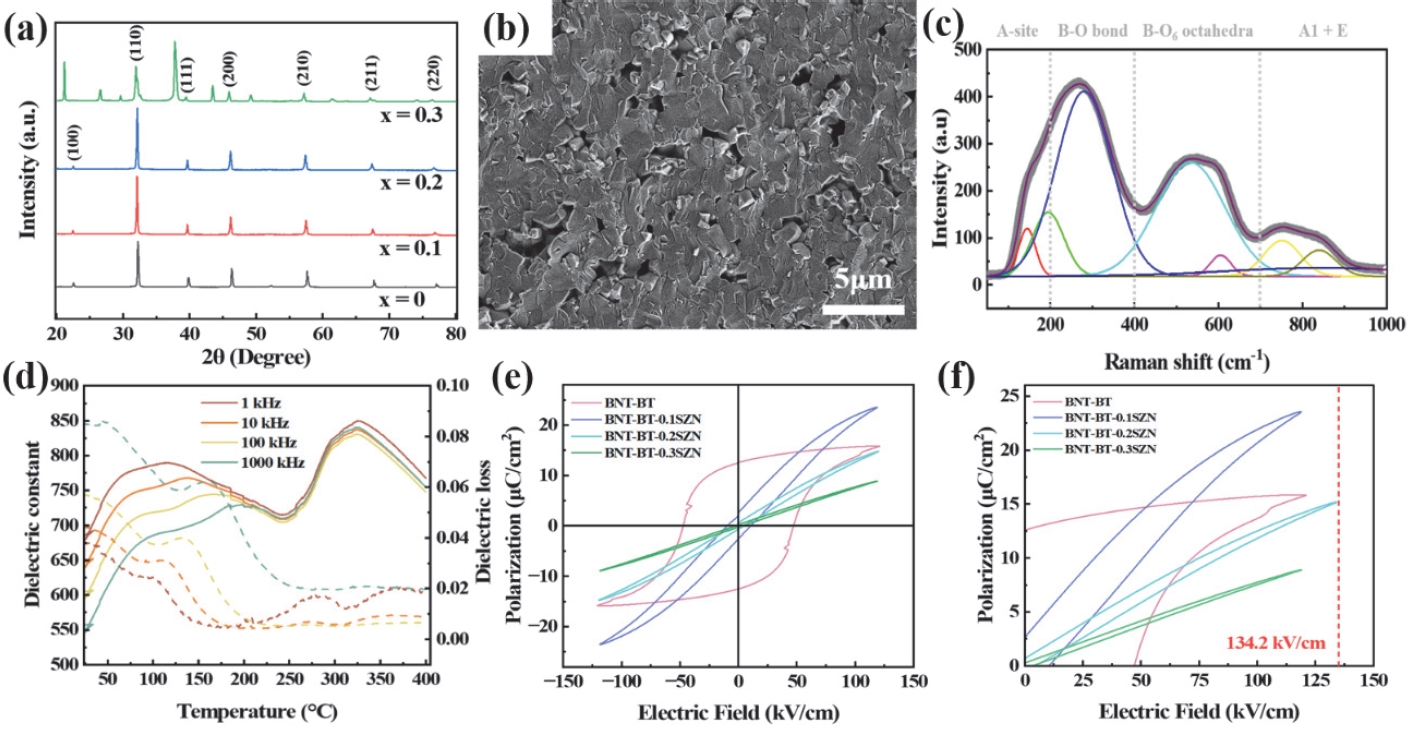
Figure 2(a) presents the X-ray diffraction (XRD) patterns of (1-x) (BNT-BT)-xSZN ceramics with increasing SZN content. The undoped BNT-BT sample shows clear peak splitting associated with rhombohedral-tetragonal phase coexistence, characteristic of a morphotropic phase boundary structure. With increasing SZN addition, the peak splitting gradually diminishes and the diffraction peaks merge into single peaks, indicating a transition toward a pseudo-cubic structure. This structural evolution reflects the suppression of long-range ferroelectric order and the introduction of lattice disorder, which are essential conditions for relaxor ferroelectric behavior. The microstructural evolution is revealed by the cross-sectional scanning electron microscope (SEM) image shown in
Figure 2(b) for the composition x = 0.2. While the undoped BNT-BT ceramic exhibits loosely packed grains with noticeable porosity, the SZN-doped ceramic shows refined and uniformly distributed grains with significantly improved densification. Excessive SZN addition leads to a slight increase in porosity due to secondary phase formation and limited solubility, indicating that optimized grain refinement and densification at x = 0.2 play a crucial role in enhancing breakdown strength.
Figure 2(c) shows the Raman spectra with peak deconvolution for the x = 0.2 composition, providing insight into lattice disorder and local structural distortion. The broadening and shifting of Raman modes associated with A-site and B-site vibrations indicate enhanced ionic disorder and distortion of the TiO
6 octahedra, which are closely related to the formation of dynamic PNRs. These features confirm the stabilization of relaxor ferroelectric behavior at moderate SZN contents. The temperature-dependent dielectric properties shown in
Figure 2(d) further support the relaxor nature of the ceramics. The dielectric permittivity peaks become broader and exhibit strong frequency dispersion, while the dielectric maximum temperature shifts to lower values with SZN doping, confirming the gradual suppression of long-range ferroelectric ordering.
The x = 0.2 composition shows a well-defined relaxor response with relatively low dielectric loss, indicating good dielectric reliability.
Figures 2(e) and
2(f) illustrate the evolution of bipolar and unipolar P-E loops, respectively. With SZN incorporation, both P
r and coercive field decrease markedly, and the hysteresis loops become slim and pinched, reflecting a transition from normal ferroelectric to relaxor-dominated polarization behavior. Notably, the x = 0.2 composition exhibits the highest breakdown strength, owing to the combined effects of dense microstructure, reduced leakage pathways, and stabilized relaxor behavior. As a result, this composition achieves the best overall energy storage performance, with a high W
rec of 0.96 J cm
-3 and an energy efficiency of 87.3%. In contrast, excessive SZN addition leads to reduced P
max and deteriorated dielectric reliability, resulting in a decline in W
rec.
This study explores a compositional strategy to enhance the energy storage performance of BNT-BT-based ceramics by deliberately combining relaxor ferroelectric and antiferroelectric-like characteristics [
20]. While conventional BNT-BT systems exhibit high P
max, their energy storage performance is often limited by large P
r and insufficient breakdown strength. To overcome these challenges, SBT, a relaxor ferroelectric with low coercive field and diffuse dielectric response, is incorporated into the BNT-BT matrix. The central hypothesis is that SBT addition simultaneously disrupts long-range ferroelectric order, introduces highly dynamic PNRs, and refines the grain structure, while also inducing antiferroelectric-like pinched hysteresis behavior. By tuning the SBT content, particularly near x = 0.275, the system achieves an optimal balance between high P
max, low P
r, and enhanced breakdown strength. This relaxor-antiferroelectric coupling is proposed as an effective route to realize high recoverable energy density and improved energy efficiency in bulk lead-free ceramic capacitors.
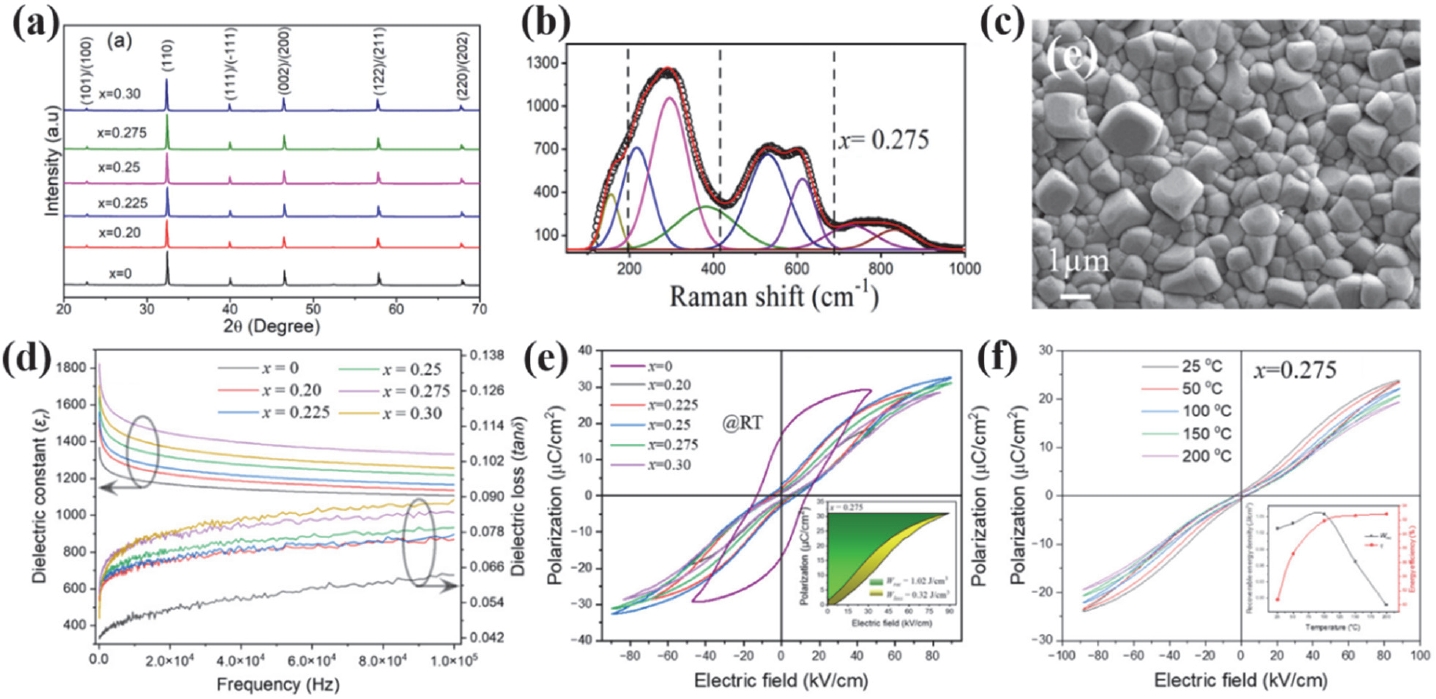
Figure 3(a) presents the XRD patterns of (1-x) BNT-BT-xSBT ceramics over the full composition range. All compositions exhibit the coexistence of rhombohedral and tetragonal phases, indicating that the system remains near a morphotropic phase boundary even after SBT incorporation. The absence of secondary phases confirms the formation of a homogeneous solid solution. A slight shift of diffraction peaks toward lower angles with increasing SBT content suggests lattice expansion caused by the substitution of larger Sr ions at the A-site, which contributes to enhanced lattice disorder and relaxor behavior.
Figure 3(b) shows the Raman spectrum with spectral deconvolution for the optimized composition x = 0.275. Compared with lower and higher SBT contents, this composition exhibits pronounced peak broadening and shifts in both A-site- and B-site-related vibrational modes. Across the entire compositional range, increasing SBT content leads to systematic broadening of Raman modes, reflecting enhanced ionic disorder and distortion of TiO
6 octahedra. These features indicate the disruption of long-range ferroelectric order and the formation of highly dynamic PNRs, which are most stabilized at x = 0.275.
Figure 3(c) displays the SEM image of the x = 0.275 ceramic, revealing a dense and homogeneous microstructure with fine, uniformly distributed grains. Compared with the undoped BNT-BT sample, which shows a relatively porous microstructure, increasing SBT content progressively refines the grain size and improves densification. Across the full compositional range, grain size decreases monotonically with SBT addition due to increased lattice strain at the A-site. The optimized microstructure at x = 0.275 plays a critical role in enhancing breakdown strength and dielectric reliability.
Figure 3(d) illustrates the frequency dependence of dielectric constant and dielectric loss at room temperature for all compositions. With increasing SBT content, the dielectric constant increases while maintaining moderate dielectric loss, reaching a maximum at x = 0.275. This improvement is attributed to enhanced polarizability arising from relaxor behavior and the dense microstructure. The overall trend indicates that SBT incorporation effectively enhances dielectric response without inducing excessive loss.
Figure 3(e) shows room-temperature bipolar P-E hysteresis loops for all compositions. The undoped BNT-BT ceramic exhibits a typical ferroelectric loop with large P
r. In contrast, SBT-doped samples display progressively slimmer and pinched hysteresis loops, reflecting the coexistence of relaxor and antiferroelectric-like responses. The x = 0.275 composition exhibits a minimized hysteresis loop with high P
max and low P
r, which is essential for high energy storage efficiency.
Figure 3(f) presents bipolar P-E loops of the x = 0.275 composition measured at elevated temperatures. The W
rec initially increases with temperature due to enhanced polarization response, followed by a decrease at higher temperatures associated with depolarization and phase instability. This behavior confirms that energy storage performance is closely linked to the stability of the relaxor-antiferroelectric state. With increasing SBT content, P
r and coercive field decrease significantly, while breakdown strength increases markedly, reaching a maximum at x = 0.275. As a result, the x = 0.275 composition achieves the highest W
rec of approximately 1.02 J cm
-3 and an energy efficiency of about 76.0%. Excessive SBT addition further reduces P
r but leads to a decline in breakdown strength and W
rec, highlighting the importance of optimized compositional design.
2.3 Domain Engineering in Bi0.5(Na0.8K0.2)0.5TiO3-Bi0.2Sr0.7TiO3 (BNKT-BST) Relaxor Ferroelectric Ceramics for Enhanced Energy Storage Performance
A domain-engineering strategy was explored to enhance the energy-storage performance of BNKT-based relaxor ferroelectric ceramics through the incorporation of BST. Although BNKT possesses strong intrinsic polarization arising from the stereochemically active Bi
3+ lone pair and exhibits relaxor characteristics near the morphotropic phase boundary, its practical energy-storage capability remains constrained by relatively large and insufficient breakdown strength. In a recent study, the introduction of BST was designed to disrupt long-range ferroelectric ordering, promote highly dynamic PNRs, and refine the microstructure, thereby driving a macroscopic ferroelectric-to-relaxor transition [
21]. By systematically varying the BST content, clear correlations were established among phase structure, lattice disorder, microstructural evolution, dielectric relaxor behavior, and energy-storage performance, with particular attention to the optimized composition at x = 0.45.
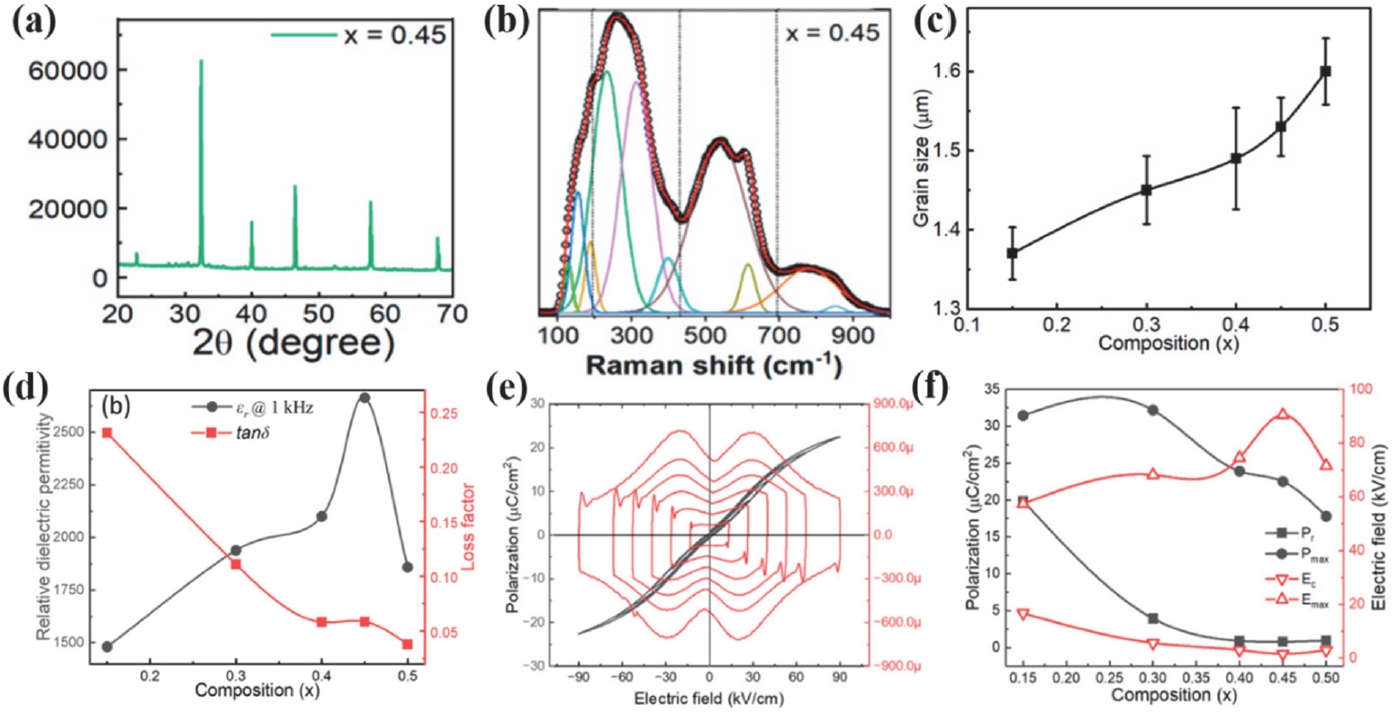
Figure 4(a) shows the XRD pattern of (1-x) BNKT-BST ceramics at x = 0.45. All compositional samples (x = 0.15, 0.30, 0.40, 0.45, and 0.5) exhibit the coexistence of rhombohedral and tetragonal phases, indicating that the system remains near a morphotropic phase boundary after BST incorporation. For the optimized composition x = 0.45, clear peak splitting associated with the rhombohedral-tetragonal phase coexistence is preserved, while the diffraction peaks shift slightly toward lower angles compared to lower BST contents. Across the composition range, this systematic peak shift reflects lattice expansion induced by the substitution of larger Sr ions at the A-site, which enhances lattice disorder and suppresses long-range ferroelectric ordering.
Figure 4(b) presents the Raman spectra with spectral deconvolution for BNKT-BST ceramics, with particular emphasis on the x = 0.45 composition. For x = 0.45, pronounced broadening and shifting of Raman modes associated with both A-site vibrations and TiO
6 octahedral modes are observed, indicating enhanced ionic disorder and local structural distortion. As BST content increases, Raman modes gradually broaden and shift across the entire compositional range, reflecting the progressive disruption of long-range ferroelectric order and the stabilization of highly dynamic PNRs. The x = 0.45 composition exhibits an optimal balance between lattice disorder and structural stability, which is essential for robust relaxor ferroelectric behavior.
Figure 4(c) summarizes the variation in average grain size as a function of BST content, together with SEM observations of microstructural evolution. With increasing BST incorporation, the grain size gradually increases from approximately 1.37 μm at x = 0.15 to about 1.6 μm at x = 0.45, attributed to enhanced mass transport and oxygen vacancy formation induced by Sr substitution at the A-site. SEM images reveal that all compositions exhibit uniformly distributed, rectangular-shaped grains, while the x = 0.45 composition shows the densest and most homogeneous microstructure with minimal porosity. Excessive BST addition leads to a slight degradation in densification.
The optimized grain size and dense microstructure at x = 0.45 contribute significantly to enhanced breakdown strength and dielectric reliability.
Figure 4(d) shows the variation of relative dielectric permittivity and dielectric loss as a function of BST content. As BST content increases, the dielectric permittivity gradually increases and reaches a maximum value of approximately 2664 at x = 0.45, while dielectric loss decreases to a minimum of about 0.058. This compositional trend indicates that BST incorporation enhances polarizability while simultaneously suppressing dielectric loss. The improved dielectric response is attributed to the formation of dynamic PNRs and the dense microstructure achieved through domain engineering.
Figure 4(e) displays the room-temperature bipolar P-E hysteresis loop of the x = 0.45 composition. Compared with lower BST contents, the loop becomes significantly slimmer, exhibiting low P
r and moderate P
max. This behavior indicates the dominance of reversible polarization associated with highly dynamic PNRs rather than irreversible domain wall motion. The slim P-E loop is essential for achieving high energy efficiency in dielectric capacitors.
Figure 4(f) summarizes the compositional dependence of P
r, P
max, and breakdown electric field. With increasing BST content, P
r and coercive field decrease sharply, while breakdown strength increases and reaches a maximum value of 90 kV cm
-1 at x = 0.45. This trend highlights the effectiveness of BST-induced domain engineering in suppressing irreversible domain switching and enhancing dielectric reliability. With increasing BST content, P
r decreases from 19.9 μC cm
-2 at x = 0.15 to 0.78 μC cm
-2 at x = 0.45, while breakdown strength increases significantly. Consequently, the x = 0.45 composition achieves the highest W
rec of 0.81 J cm
-3 and an energy efficiency of 87.0%. Further BST addition leads to reduced P
max and breakdown strength, resulting in diminished energy storage performance.
This study systematically investigates how A-site acceptor and donor doping influence phase transition behavior, microstructure, and electromechanical properties of BNT relaxor ceramics [
22]. Li
+ and La
3+ were selected as representative acceptor and donor dopants, respectively, to clarify the role of oxygen vacancies in governing the NER to ergodic relaxor (ER) transition. While conventional BNT exhibits high P
r and Curie temperature, its practical performance is limited by a large coercive field and strong hysteresis, which originate from frozen PNRs and oxygenvacancy-related defect complexes. The central objective of this work is to demonstrate that controlling oxygen vacancy concentration through A-site doping provides a powerful route to tailor relaxor state stability, dielectric response, and electromechanical strain behavior in BNT ceramics.
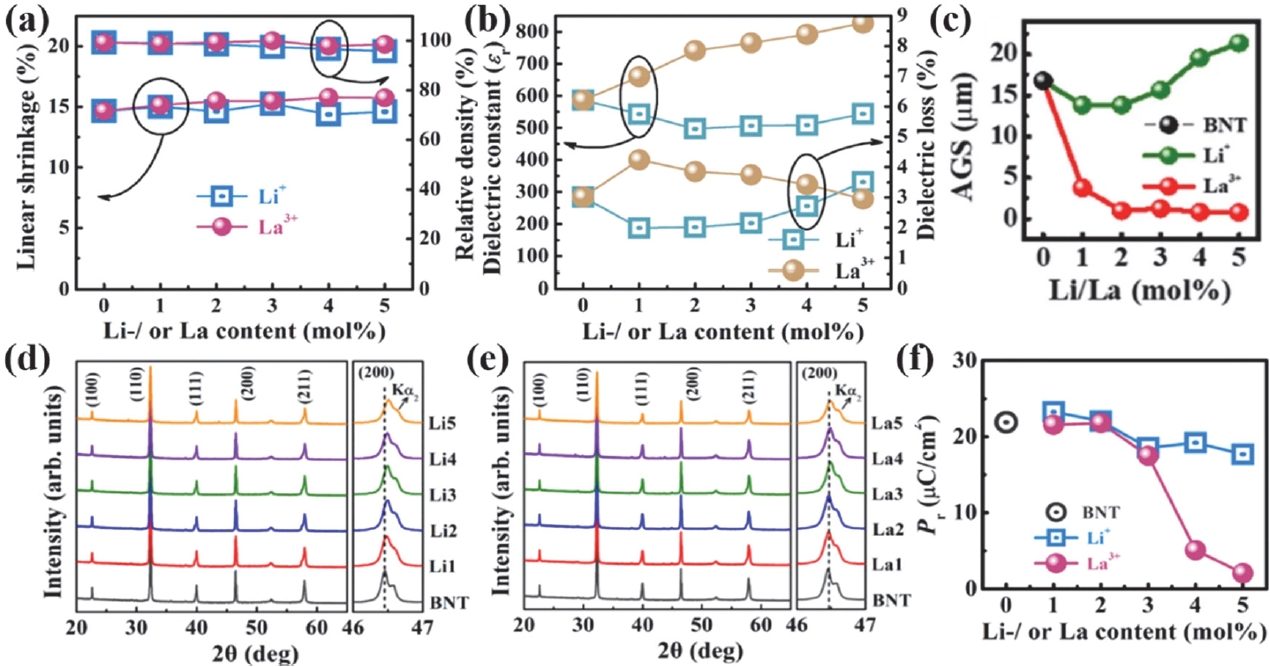
Figure 5(a) shows the linear shrinkage and relative density of Liand La-doped BNT ceramics as a function of dopant concentration. All compositions exhibit similar shrinkage values of approximately 15% and achieve relative densities above 95%, confirming that the selected sintering temperature is suitable for both dopant systems. La-doped ceramics show slightly higher shrinkage and density than Li-doped ones, indicating improved densification associated with donor doping and suppressed volatilization-induced defects.
Figure 5(b) compares the room-temperature dielectric constant and dielectric loss of Li- and La-doped BNT ceramics. Li-doped samples show nearly constant dielectric constant with increasing Li content, reflecting limited influence on polarization dynamics. In contrast, La doping leads to a pronounced increase in dielectric constant with composition, indicating enhanced relaxor behavior. Dielectric loss in La-doped ceramics initially increases at low doping levels but decreases at higher concentrations, suggesting stabilization of the relaxor state and reduced energy dissipation due to suppressed oxygen vacancy concentration.
Figure 5(c) summarizes the variation of average grain size as a function of Li or La content, together with SEM observations. Li doping results in a gradual increase in grain size, attributed to enhanced sinterability induced by acceptor-type defect chemistry. Conversely, La doping leads to a dramatic reduction in grain size down to the sub-micrometer scale as La content increases. SEM images reveal dense microstructures for all compositions; however, La-doped ceramics exhibit finer and more uniform grains due to dopant segregation at grain boundaries. This grain refinement plays an important role in modifying dielectric and electromechanical responses.
Figure 5(d) presents the XRD patterns of Li-doped BNT ceramics. All compositions retain a single-phase perovskite structure without detectable secondary phases. With increasing Li content, diffraction peaks shift slightly toward higher angles, indicating lattice contraction caused by the smaller ionic radius of Li
+. Despite these shifts, no significant change in average crystal symmetry is observed, suggesting that Li doping does not strongly alter the long-range structural framework of BNT.
Figure 5(e) shows the XRD patterns of La-doped BNT ceramics. Similar to the Li-doped case, all samples exhibit a single perovskite phase. However, peak positions remain nearly unchanged with increasing La content, reflecting the comparable ionic radius of La
3+ to the host A-site cations. These results indicate that La doping mainly affects local structural disorder rather than inducing macroscopic lattice distortion.
Figure 5(f) plots the P
r of Li- and La-doped BNT ceramics as a function of dopant content. Compared with undoped BNT, La doping leads to a pronounced reduction in P
r with increasing La content, whereas Li doping shows a more moderate change in P
r over the investigated range. This behavior is characteristic of an ER state, in which polarization is dominated by reversible field-induced responses of dynamic PNRs rather than irreversible domain switching. In addition to polarization behavior, the electromechanical strain response provides further insight into the relaxor state transition. Li-doped BNT ceramics show nearly unchanged strain behavior with increasing Li content, consistent with the absence of a significant phase transition. In contrast, La-doped ceramics exhibit a strong composition- dependent strain response. At intermediate La concentrations, the strain increases markedly and transitions from a conventional butterfly-shaped curve to a large, reversible electrostrictive-like response. This enhancement is closely associated with the stabilization of the ergodic relaxor phase, where reversible field-induced phase transformation leads to high strain efficiency. Excessive La doping, however, results in reduced strain due to over-softening of the lattice and weakened polarization response. Unlike BNT-BT-based energy storage studies that rely on phase boundary and compositional engineering, this work highlights A-site defect chemistry as the key factor controlling relaxor state stabilization. By linking acceptor/donor doping to oxygen vacancy regulation and the NER to ER transition, it offers a defect-driven perspective distinct from conventional BNT-BT energy storage approaches.
2.5 Ferroelectric Phase Evolution and Functional Property Optimization in Y-Doped BNT-BT Ceramics
The effect of A-site Y
3+ doping on ferroelectric phase evolution and the resulting dielectric and piezoelectric properties of BNT-BT ceramics near the morphotropic phase boundary was systematically examined in a recent study [
23]. Although BNT-BT systems exhibit strong polarization, their functional performance is often constrained by high coercive fields and thermally unstable dielectric responses. Incorporation of Y
3+ was intended to regulate lattice distortion, suppress long-range ferroelectric ordering, and enhance relaxor characteristics through controlled phase evolution. By varying the Y content in a systematic manner, clear correlations were identified among crystal structure, microstructure, ferroelectric behavior, and temperature-stable functional performance.
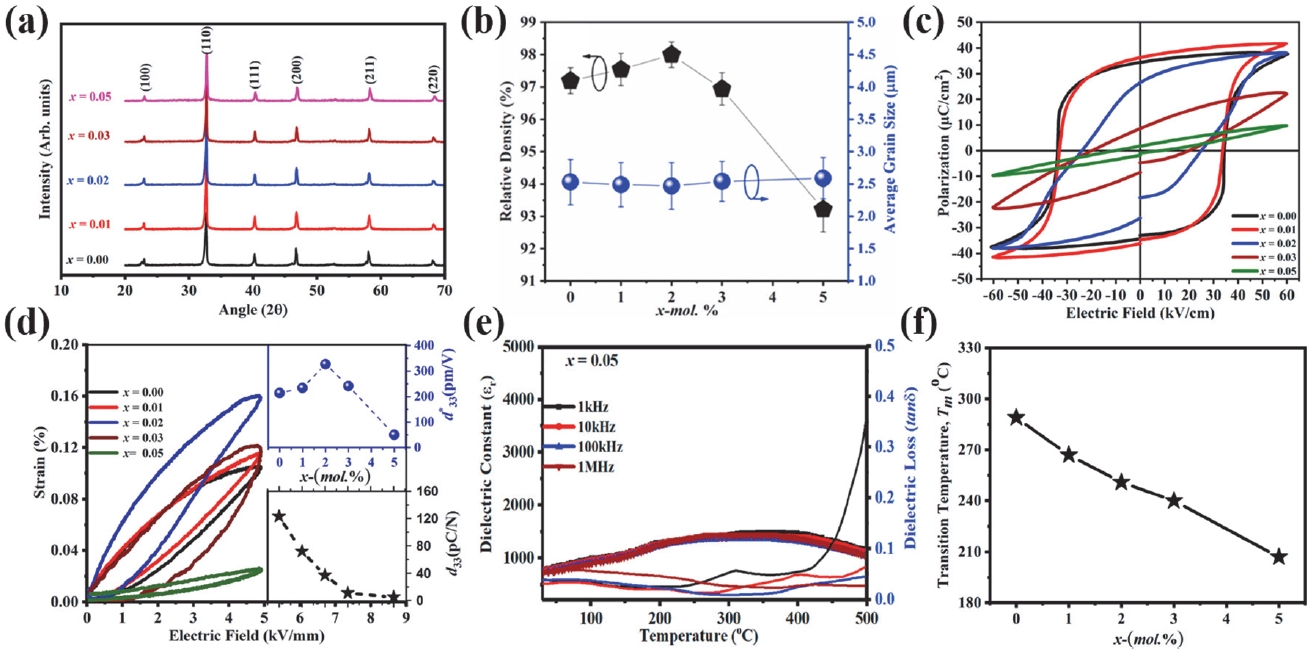
Figure 6(a) presents the XRD patterns of Y-doped BNT-BT ceramics with increasing Y content. All compositions retain a single perovskite structure without secondary phases, confirming successful solid-solution formation. With increasing Y concentration, diffraction peaks gradually shift toward higher angles, indicating lattice contraction due to the smaller ionic radius of Y
3+. The analysis reveals a gradual transition from a rhombohedral-tetragonal mixed ferroelectric state toward a pseudo-cubic relaxor-dominated structure, reflecting suppressed long-range ferroelectric ordering.
Figure 6(b) summarizes the variation of relative density and average grain size as a function of Y content, together with SEM observations. At low Y concentrations, the ceramics exhibit dense microstructures with well-developed grains and high relative density. The average grain size remains nearly constant across compositions, indicating that Y doping does not strongly promote abnormal grain growth. However, the relative density reaches a maximum at intermediate Y content, suggesting improved sintering behavior due to suppressed volatilization of A-site species. As the Y content increases, slight grain refinement and reduced density are observed, consistent with dopant segregation at grain boundaries and increased lattice disorder.
Figure 6(c) compares the bipolar P-E hysteresis loops of Y-doped BNT-BT ceramics. The undoped composition shows a typical ferroelectric loop with large P
r and coercive field. With increasing Y content, the hysteresis loops progressively become slimmer, accompanied by reduced P
r and coercive field. This evolution indicates a gradual transition from normal ferroelectric to relaxor-dominated polarization behavior. Both P
r and coercive field decrease monotonically with increasing Y concentration, confirming the suppression of irreversible domain switching. This trend highlights the role of Y doping in stabilizing a more reversible polarization response favorable for functional applications.
Figure 6(d) shows the unipolar strain-electric field response of Y-doped BNT-BT ceramics under 5 kV mm
-1. The strain behavior strongly depends on Y content. The composition with x = 0.02 exhibits the highest unipolar strain of approximately 0.14%, significantly larger than the undoped composition. This enhancement corresponds to the coexistence of ferroelectric and relaxor phases at the phase boundary, which enables reversible field-induced polarization rotation and domain switching. The upper inset presents the dynamic piezoelectric coefficient (d*33) calculated from the unipolar strain curves. The maximum value of 327 pm/V is achieved at x = 0.02, confirming that this composition lies near the ferroelectric–relaxor phase boundary where electromechanical coupling is maximized. The lower inset shows the static piezoelectric constant (d
33), which decreases gradually with increasing Y content.
Figure 6(e) presents the temperature-dependent dielectric permittivity and dielectric loss of the x = 0.05 composition measured from 30 to 500°C. Compared with lower Y concentrations, the dielectric peak becomes significantly broadened and shifted to lower temperatures, indicating strong relaxor characteristics and enhanced diffuseness. Most notably, the x = 0.05 composition exhibits outstanding dielectric stability: the relative permittivity remains within ±15% variation from approximately 97°C to 500°C. This wide stability window is substantially broader than that of undoped BNT-BT, where dielectric stability is limited to a narrower high-temperature range. The reduction in dielectric loss at elevated temperatures is attributed to suppression of oxygen-vacancy-related conduction through Y substitution, which reduces Bi volatility and defect concentration.
Figure 6(f) summarizes the evolution of phase transition temperatures as a function of Y content. The ferroelectric-relaxor transition temperature systematically decreases with increasing Y concentration, indicating progressive destabilization of long-range ferroelectric order. At higher Y contents, the disappearance of a distinct ferroelectric transition confirms the stabilization of a relaxor state over a broad temperature range. This phase evolution provides a fundamental explanation for the observed trends in dielectric and electromechanical properties.
2.6 Thermally Stable Energy Storage in BNKT-Based Relaxor Ceramics via BaBi2Nb2O9 Solid-Solution Engineering
This study aims to improve the energy storage performance and thermal stability of BNKT-based relaxor ferroelectric ceramics by incorporating BaBi
2Nb
2O
9 (BBN), a bismuth-layered ferroelectric with high electrical insulation and structural stability [
24]. Although BNKT ceramics exhibit large P
max and relaxor characteristics favorable for energy storage, their practical application is limited by significant energy loss and strong temperature dependence of dielectric and polarization responses. The introduction of BBN is designed to suppress electric-field-induced long-range ferroelectric ordering, refine the microstructure, and enhance breakdown strength, thereby achieving stable and efficient energy storage over a wide temperature range.
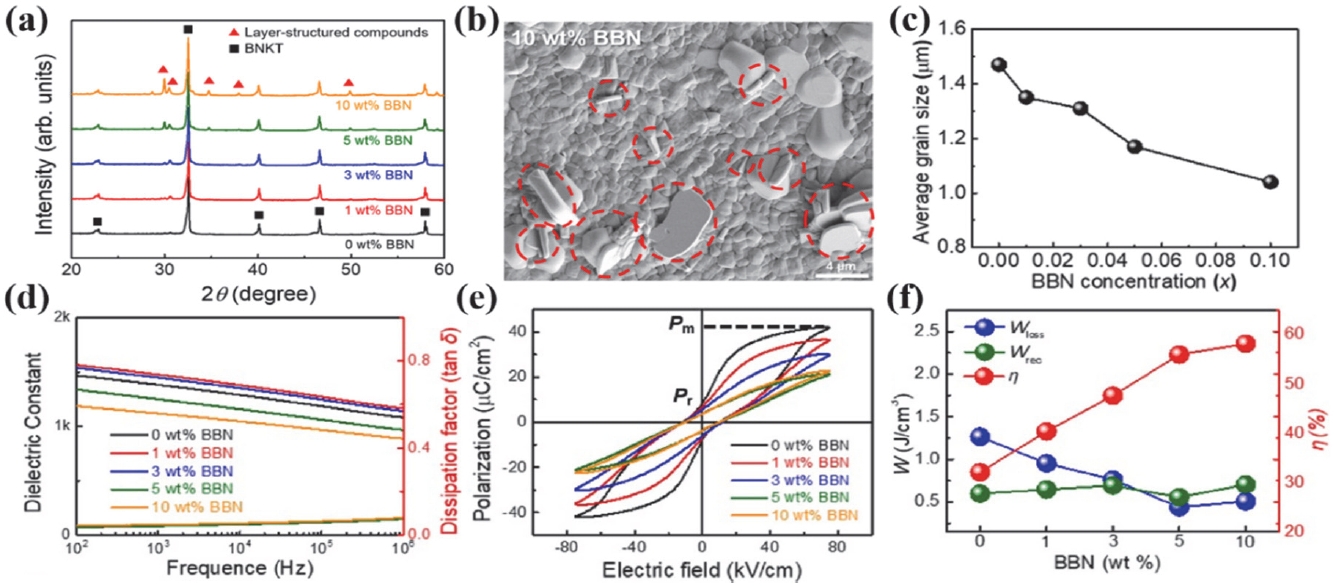
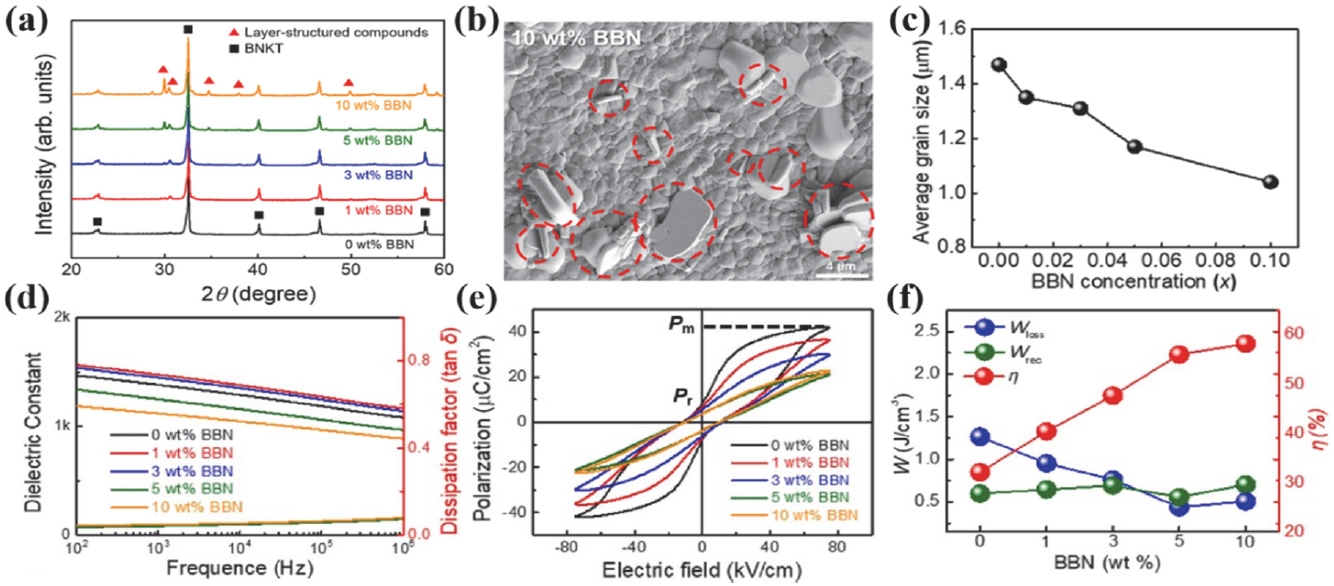
Figure 7(a) shows the XRD patterns of BNKT-BBN ceramics with varying BBN content. All compositions maintain the perovskite structure of BNKT without detectable secondary phases, indicating successful solid-solution formation. With increasing BBN content, diffraction peaks broaden slightly and shift, suggesting increased lattice distortion and structural heterogeneity. This gradual phase evolution reflects enhanced disorder in the perovskite lattice, which is beneficial for stabilizing relaxor behavior and suppressing long-range ferroelectric order.
Figure 7(b) shows the surface SEM image of the BNKT-BBN ceramic containing 10 wt% BBN. The microstructure is characterized by fine and uniformly distributed grains with good densification. Compared with lower BBN contents, the 10 wt% composition exhibits suppressed grain growth and a more homogeneous microstructure, which contributes to enhanced electrical homogeneity and improved breakdown strength.
Figure 7(c) summarizes the variation in average grain size as a function of BBN content, together with SEM observations. The average grain size decreases monotonically with increasing BBN addition, indicating that BBN effectively inhibits grain growth during sintering. SEM images reveal that pure BNKT ceramics exhibit relatively large grains, whereas BBN-modified samples show finer and more uniform grains with improved microstructural homogeneity. This grain refinement reduces local electric-field concentration and contributes significantly to the enhancement of breakdown strength.
Figure 7(d) compares the room-temperature dielectric constant and dielectric loss of BNKT-BBN ceramics with varying BBN content. A slight increase in dielectric constant is observed at low BBN addition, followed by a gradual decrease at higher contents due to the increased fraction of layered-structure components. Despite this decrease, all compositions exhibit pronounced frequency dispersion and relatively low dielectric loss, confirming the retention of relaxor ferroelectric characteristics.
Figure 7(e) shows the bipolar P-E hysteresis loops of BNKT-BBN ceramics. The undoped BNKT sample exhibits a pinched hysteresis loop characteristic of an ER. With increasing BBN content, the P-E loops become progressively slimmer, accompanied by a significant reduction in P
r and hysteresis loss. This behavior indicates that BBN incorporation effectively suppresses field-induced long-range ferroelectric ordering and promotes reversible polarization processes. As the BBN content increases, W
rec remains at a competitive level, while energy loss is significantly reduced due to suppressed P
r and enhanced breakdown strength.
Figure 7(f) summarizes the key energy storage parameters extracted from the P-E loops, including W
rec and energy efficiency. The optimized compositions exhibit markedly improved energy efficiency, demonstrating that BBN incorporation effectively balances polarization response and dielectric reliability. Compared with BNT-BT and conventional BNKT-based energy storage studies that primarily rely on phase boundary tuning or relaxor stabilization to improve W
rec, this work emphasizes loss suppression through layered-compound incorporation. This approach complements BNT-BT strategies by demonstrating that structural heterogeneity and microstructural refinement can be as critical as phase engineering for energy storage applications.
3 Conclusion
BNT-based lead-free relaxor ferroelectric ceramics are a promising material platform for electrostatic energy-storage capacitors because they can deliver high P
max with low P
r and slim or pinched P-E hysteresis loops, arising from dynamic PNRs. Nevertheless, pristine BNT is intrinsically constrained by large coercive fields, pronounced hysteresis, and limited dielectric breakdown strength, so practical energy-storage performance requires deliberate stabilization of relaxor states together with improved electrical reliability. From the six representative studies reviewed in this paper, a unified conclusion can be drawn: high-performance energy storage in bulk BNT-related ceramics is achieved when reversible polarization is maximized while irreversible domain switching, conduction loss, and electrical inhomogeneity are suppressed through coordinated control of composition, defect chemistry, phase structure, and microstructure. In solid-solution designs near phase boundaries, chemical disorder and structural frustration promote relaxor behavior and reduce Pr, enabling slimmer loops and higher recoverability. Additives that introduce secondary relaxor or antiferroelectric-like characteristics further enhance loop pinching and loss reduction by discouraging stable long-range ferroelectric ordering, thereby improving energy-storage efficiency. Meanwhile, microstructural strategies, particularly densification and grain refinement, contribute by increasing breakdown strength and reducing leakage pathways, reinforcing the benefits of compositional design. Equally important, defect chemistry emerges as an independent and powerful design lever. A-site donor/aliovalent doping modifies oxygen-vacancy populations and defect-complex formation, which in turn tunes random fields, relaxor ergodicity, and the balance between NER and ER states. By steering the material toward a more reversible, field-responsive relaxor state, defect engineering helps convert broader, lossy hysteresis into slimmer behavior with improved recoverability. Additionally, approaches incorporating layered-related phases underscore that thermal robustness and loss suppression must be considered alongside room-temperature optimization, especially for capacitor operation over broad temperature windows. Despite substantial progress, various challenges remain before BNT-based bulk ceramics can be widely deployed in high-energy-density lead-free capacitors. Future research should emphasize: (1) systematic breakdown-strength enhancement via simultaneous control of porosity, grain-boundary conduction, and oxygen-vacancy-related leakage; (2) stabilization of temperature-insensitive relaxor responses by preventing field-induced long-range ordering and maintaining favorable PNR dynamics; (3) standardized reliability evaluation under repetitive electrical cycling, DC bias, and elevated temperature to enable meaningful cross-study comparison; and (4) device-oriented processing routes that preserve relaxor-enabled slim-loop behavior while meeting manufacturability requirements [
25]. Overall, the studies reviewed here converge on an integrated paradigm in which phase/relaxor-state engineering (PNR-driven reversibility) and defect-microstructure optimization (electrical homogeneity and insulation) are jointly required to realize next-generation lead-free dielectric capacitors based on BNT-related ceramics [
26].
Notes
-
Acknowledgement
This work was supported by a Research Grant of Pukyong National University (2024).
-
Conflict of Interest
The author (Geon-Tae Hwang) currently serves on the editorial board of JEEM, but was not involved in any part of the publication process. Other than this, the authors declare that they have no relevant potential conflicts of interest.
-
Author Contributions
Yeseul Lim: Investigation, Writing - Original Draft.
Geon-Tae Hwang: Conceptualization, Writing - Original Draft, Writing - Review & Editing, Supervision, Project administration, Funding acquisition.
Data Availability
Data sharing not applicable – no new data generated
Fig. 1.Schematically illustrates the contrast in energy storage mechanisms between pure BNT and SZN-doped BNT-BT ceramics [
19]
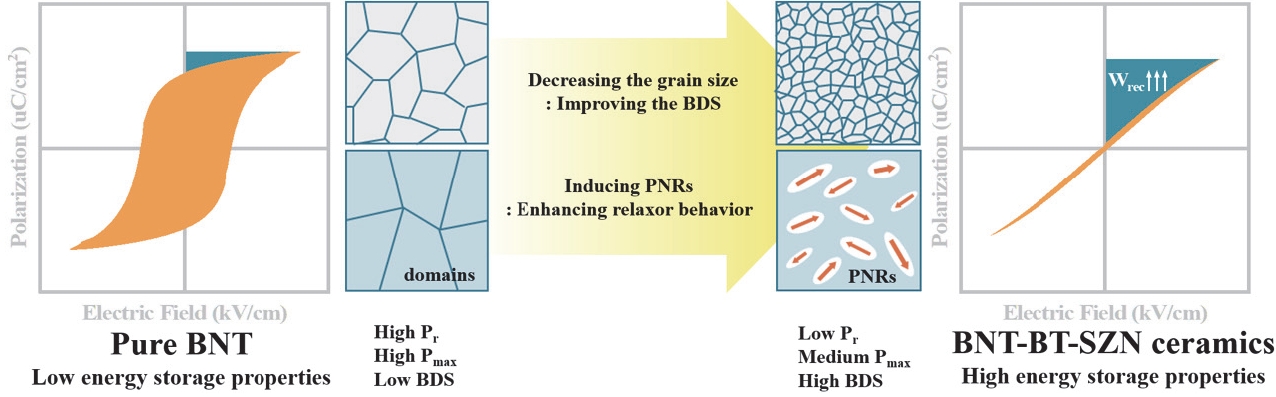
Fig. 2.(a) XRD patterns of BNT-BT-SZN ceramics with different SZN contents, (b) cross-sectional SEM image of multilayered bulk BNT-BT-SZN ceramic at x = 0.2, (c) raman spectra with spectral deconvolution of BNT-BT-SZN ceramic at x = 0.2, (d) temperature-dependent dielectric constant and dielectric loss of BNT-BT-SZN ceramic at x = 0.2 measured at different frequencies, (e) bipolar P-E hysteresis loops of BNT-BT-SZN ceramics measured at room temperature, and (f) unipolar P-E loops of BNT-BT-SZN ceramics showing the breakdown strength [
19]
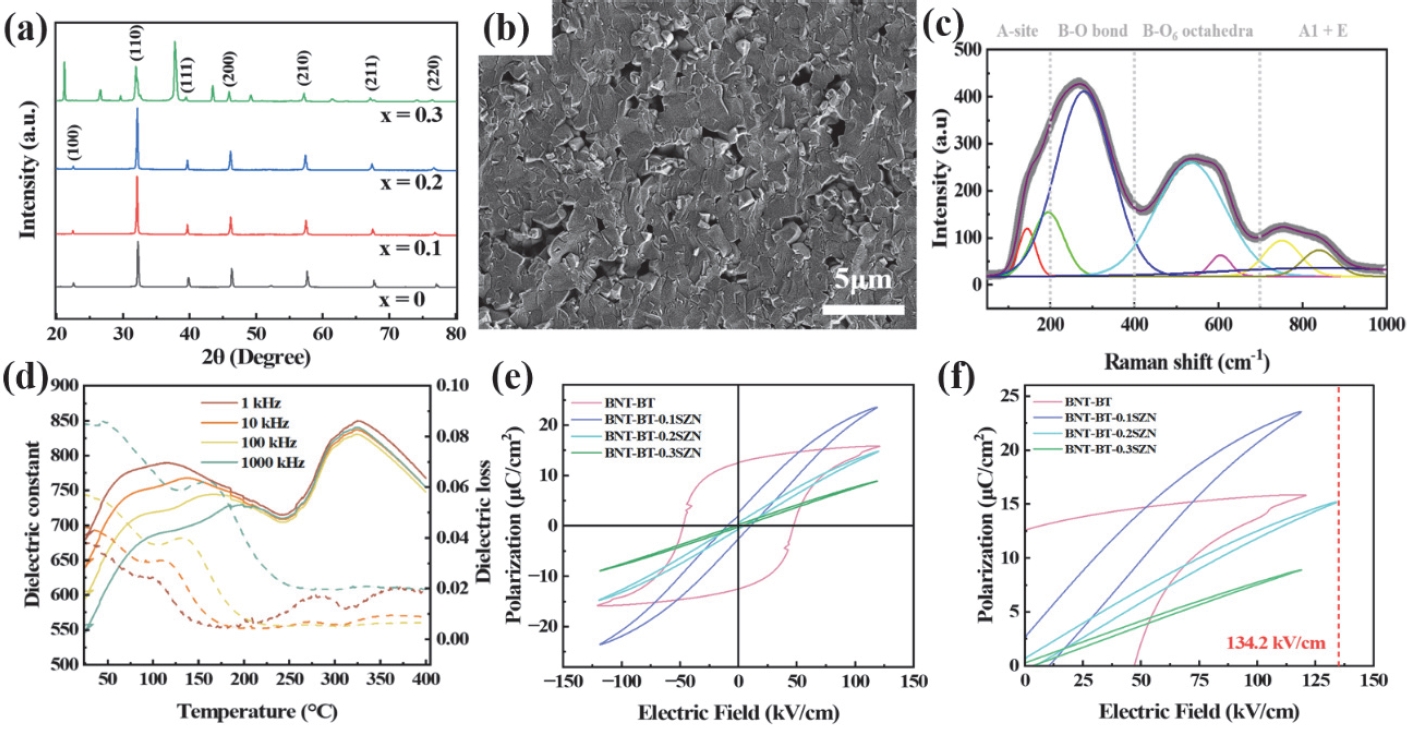
Fig. 3.(a) XRD patterns of BNT-BT-SBT ceramics, (b) raman spectrum with spectral deconvolution of BNT-BT-SBT ceramic at x = 0.275, (c) SEM image of BNT-BT-SBT ceramic at x = 0.275, (d) frequency-dependent dielectric constant and dielectric loss of BNT-BT-SBT ceramics measured at room temperature, (e) room-temperature bipolar P-E hysteresis loops of BNT-BT-SBT ceramics, and (f) temperature-dependent bipolar P-E hysteresis loops of the optimized BNT-BT-SBT ceramic (x = 0.275) measured at different temperatures [
20]
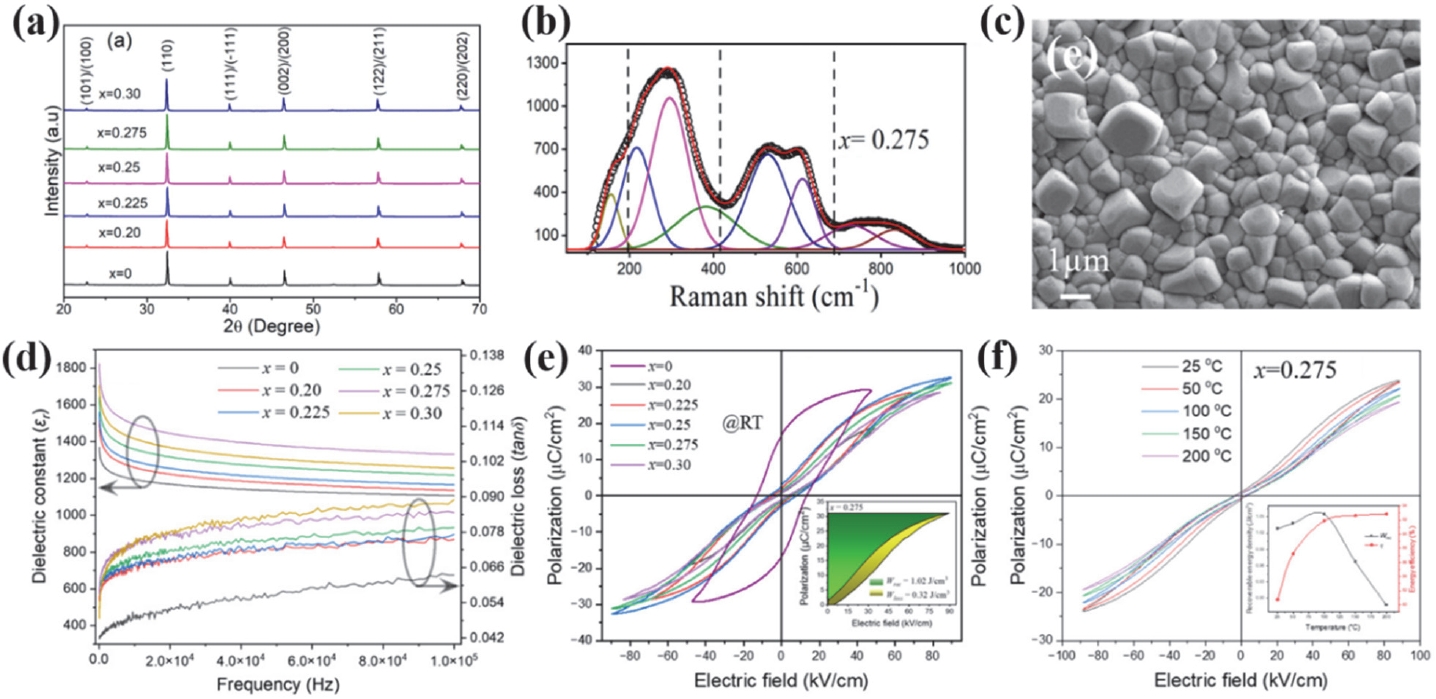
Fig. 4.(a) XRD patterns of BNKT-BST ceramics showing rhombohedral–tetragonal phase coexistence and a peak shift with increasing BST content, (b) raman spectra with spectral deconvolution of BNKT-BST ceramics, highlighting enhanced lattice disorder and polar nanoregion formation at x = 0.45, (c) variation in average grain size of BNKT-BST ceramics as a function of BST content, correlated with SEM microstructural evolution, (d) composition dependence of room-temperature dielectric permittivity and dielectric loss of BNKT-BST ceramics, (e) room-temperature bipolar P-E hysteresis loop of BNKT-BST ceramic at x = 0.45, and (f) composition dependence of polarization parameters and breakdown strength of BNKT-BST ceramics [
21]
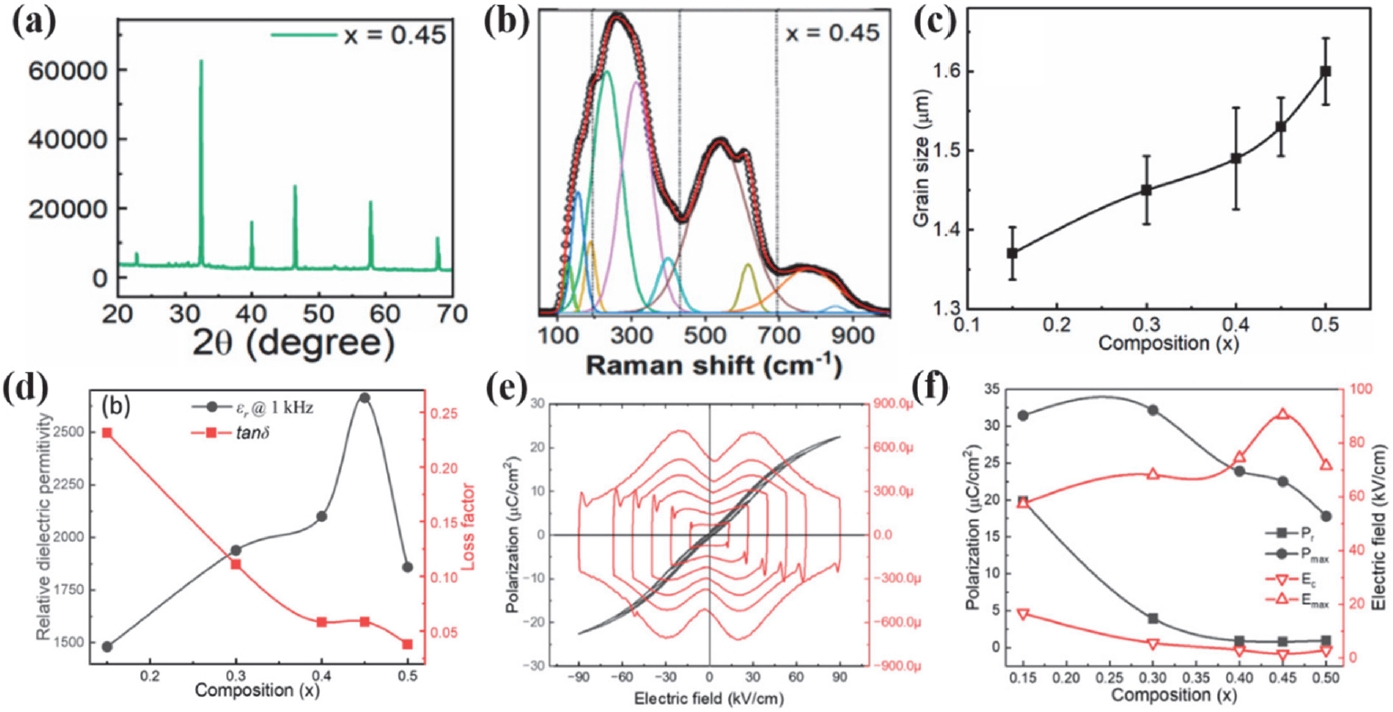
Fig. 5.(a) Linear shrinkage and relative density of Li- and La-doped BNT ceramics as a function of dopant concentration, (b) room-temperature dielectric constant and dielectric loss of Li- and La-doped BNT ceramics, highlighting distinct dielectric responses induced by acceptor and donor doping, (c) average grain size of Li- and La-doped BNT ceramics as a function of dopant concentration, correlated with SEM microstructural observations, (d) XRD patterns of Li-doped BNT ceramics, (e) XRD patterns of La-doped BNT ceramics, and (f) P
r of Li- or La-doped BNT ceramics as a function of dopant content, extracted from P-E hysteresis loops [
22]
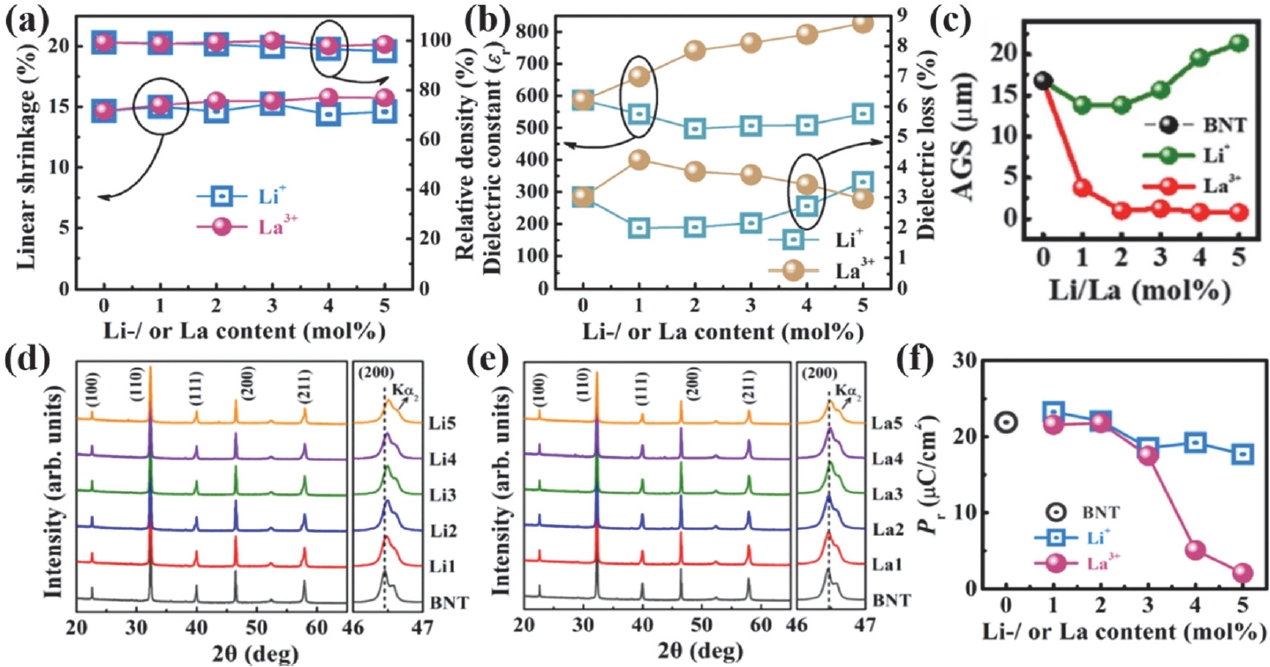
Fig. 6.(a) XRD patterns of Y-doped BNT-BT ceramics, (b) variation of relative density and average grain size of Y-doped BNT-BT ceramics as a function of composition, correlated with SEM microstructural evolution, (c) bipolar P-E hysteresis loops of Y-doped BNT-BT ceramics, (d) unipolar strain-electric field response of Y-doped BNT-BT ceramics. The upper inset shows d
*33 values derived from unipolar strain measurements. The lower inset presents d33 values as a function of Y content, (e) temperature-dependent dielectric permittivity and dielectric loss of Y-doped BNT-BT ceramic at x = 0.05, and (f) composition-dependent phase transition temperatures of Y-doped BNT-BT ceramics [
23]
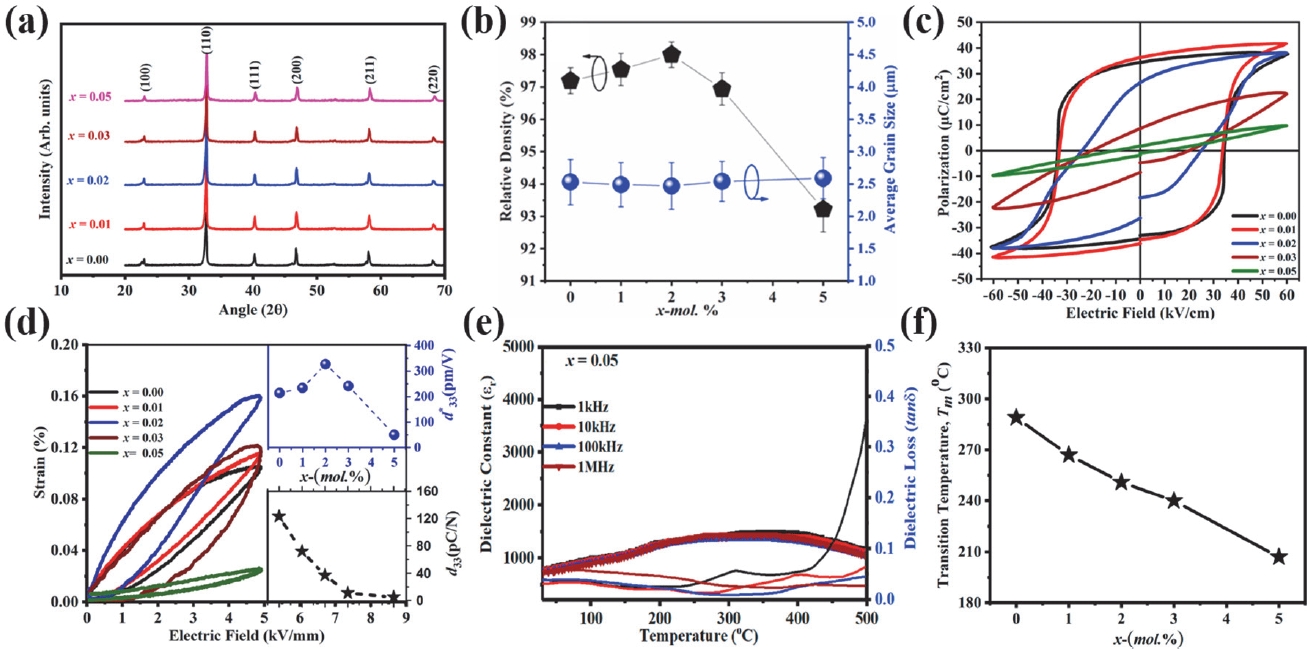
Fig. 7.(a) XRD patterns of BNKT-BBN ceramics, (b) surface SEM image of BNKT-BBN ceramic with 10 wt% BBN, (c) variation in average grain size of BNKT-BBN ceramics as a function of BBN content, with corresponding SEM images, (d) composition-dependent dielectric constant and dielectric loss of BNKT-BBN ceramics measured at room temperature, (e) bipolar P-E hysteresis loops of BNKT-BBN ceramics, and (f) summary of energy storage parameters of BNKT-BBN ceramics extracted from P-E loops [
24]
References
- 1. Q. Yuan, M. Chen, S. Zhan, Y. Li, Y. Lin, and H. Yang, Chem. Eng. J., 446, 136315 (2022). doi: https://doi.org/10.1016/j.cej.2022.136315
- 2. F. Z. Yao, Q. Yuan, Q. Wang, and H. Wang, Nanoscale, 12, 17165 (2020). doi: https://doi.org/10.1039/D0NR04479B
- 3. H. Zubairi, Z. Lu, Y. Zhu, I. M. Reaney, and G. Wang, Chem. Soc. Rev., 53, 10761 (2024). doi: https://doi.org/10.1039/D4CS00536H
- 4. A. Jan, H. Liu, H. Hao, Z. Yao, M. Cao, S. A. Arbab, M. Tahir, M. Appiah, A. Ullah, M. Emmanuel, A. Ullah, and A. Manan, J. Mater. Chem., 8, 8962 (2020). doi: https://doi.org/10.1039/D0TC01786H
- 5. A. A. Bokov and Z. G. Ye, J. Mater. Sci., 41, 31 (2006). doi: https://doi.org/10.1007/s10853-005-5915-7
- 6. B. Yang, Y. Liu, R. J. Jiang, S. Lan, S. Z. Liu, Z. Zhou, L. Dou, M. Zhang, H. Huang, L. Q. Chen, Y. L. Zhu, S. Zhang, X. L. Ma, C. W. Nan, and Y. H. Lin, Nature, 637, 1104 (2025). doi: https://doi.org/10.1038/s41586-024-08505-7
- 7. S. Supriya, J. Inorg. Organomet. Polym. Mater., 32, 3659 (2022). doi: https://doi.org/10.1007/s10904-022-02418-6
- 8. C. Bin, X. Hou, L. Liao, Y. Liu, H. Yang, Y. Liu, and J. Wang, Appl. Phys. Lett., 123, 012901 (2023). doi: https://doi.org/10.1063/5.0158219
- 9. B. Guo, F. Jin, L. Li, Z. Z. Pan, X. W. Xu, and H. Wang, Rare Met., 43, 853 (2024). doi: https://doi.org/10.1007/s12598-023-02452-4
- 10. J. F. Trelcat, C. Courtois, M. Rguiti, A. Leriche, P. H. Duvigneaud, and T. Segato, Ceram. Int., 38, 2823 (2012). doi: https://doi.org/10.1016/j.ceramint.2011.11.053
- 11. D. Hu, Z. Pan, X. Zhang, H. Ye, Z. He, M. Wang, S. Xing, J. Zhai, Q. Fu, and J. Liu, J. Mater. Chem. C., 8, 591 (2020). doi: https://doi.org/10.1039/C9TC05528B
- 12. L. Zheng, P. Sun, P. Zheng, W. Bai, L. Li, F. Wen, J. Zhang, N. Wang, and Y. Zhang, J. Mater. Chem. C., 9, 5234 (2021). doi: https://doi.org/10.1039/D1TC00437A
- 13. F. Yang, M. Li, L. Li, P. Wu, E. Pradal-Velázquez, and D. C. Sinclair, J. Mater. Chem. A., 6, 5243 (2018). doi: https://doi.org/10.1039/C7TA09245H
- 14. L. E. Cross, Ferroelectrics, 151, 305 (1994). doi: https://doi.org/10.1080/00150199408244755
- 15. T. Tunkasiri and G. Rujijanagul, J. Mater. Sci. Lett., 15, 1767 (1996). doi: https://doi.org/10.1007/BF00275336
- 16. L. Wu, Z. Cai, C. Zhu, P. Feng, L. Li, and X. Wang, Appl. Phys. Lett., 117, 212902 (2020). doi: https://doi.org/10.1063/5.0027405
- 17. F. Yan, J. Quan, S. Wang, and J. Zhai, Nano Energy, 123, 109394 (2024). doi: https://doi.org/10.1016/j.nanoen.2024.109394
- 18. W. Zhu, Z. Y. Shen, W. Deng, K. Li, W. Luo, F. Song, X. Zeng, Z. Wang, and Y. Li, J. Materiomics, 10, 86 (2024). doi: https://doi.org/10.1016/j.jmat.2023.05.002
- 19. Y. Lim, S. Pattipaka, H. Song, D. Kim, S. I. Jeong, Y. H. Son, S. Noh, M. Peddigari, J. Ryu, C. K. Jeong, and G. T. Hwang, J. Korean Ceram. Soc., 1, (2026). doi: https://doi.org/10.1007/s43207-025-00564-4
- 20. S. Pattipaka, Y. Lim, Y. Jeong, M. Peddigari, Y. Min, J. W. Jeong, J. Jang, S. D. Kim, and G. T. Hwang, Materials, 17, 5044 (2024). doi: https://doi.org/10.3390/ma17205044
- 21. S. Pattipaka, H. Choi, Y. Lim, K. I. Park, K. Chung, and G. T. Hwang, Materials., 16, 4912 (2023). doi: https://doi.org/10.3390/ma16144912
- 22. N. L. Vu, T. A. Duong, Y. Kang, M. S. Park, C. W. Ahn, and H. S. Han, J. Korean Ceram. Soc., 62, 1030 (2025). doi: https://doi.org/10.1007/s43207-025-00530-0
- 23. M. Aamir, S. A. Khan, T. Ahmed, A. Hussain, and S. Lee, Solid State Sci., 139, 107169 (2023). doi: https://doi.org/10.1016/j.solidstatesciences.2023.107169
- 24. S. Y. Cho, S. H. Han, B. H. Kim, M. K. Lee, S. W. Wi, Y. S. Lee, and S. D. Bu, Mater. Chem.Phys., 314, 128864 (2024). doi: https://doi.org/10.1016/j.matchemphys.2023.128864
- 25. E. S. Kang, S. J. Hyoung, Y. Kang, M. S. Park, T. A. Duong, J. S. Lee, and H. S. Han, J. Korean Inst. Electr. Electron. Mater. Eng., 37, 457 (2024). doi: https://doi.org/10.4313/JKEM.2024.37.4.15
- 26. T. S. Yeo, J. H. Lee, and W. Jo, J. Korean Inst. Electr. Electron. Mater. Eng., 37, 533 (2024). doi: https://doi.org/10.4313/JKEM.2024.37.5.10